Tennis Bracelet Clasp Types Explained
Compare common clasp mechanisms, secondary safety features, daily checks and maintenance before choosing a diamond tennis bracelet in Dubai.
The clasp is one of the most important parts of a tennis bracelet.
A tennis bracelet may contain carefully matched diamonds and precisely connected links, but its everyday security still depends heavily on the closure. The clasp must hold the bracelet firmly while remaining comfortable, practical to operate and proportionate to the design.
Many tennis bracelets use more than one security feature. A main box or tongue-and-groove clasp may be supported by one or two side safety latches. Other designs use push-button mechanisms, fold-over clasps or lobster-style closures.
Understanding tennis bracelet clasp types can help buyers compare security, convenience and maintenance before selecting a bracelet.
This guide focuses specifically on clasp construction and safety. It explains how common closures work, what secondary safety mechanisms do, how to inspect a clasp and which warning signs may indicate that professional attention is needed.
Integrated locking mechanisms commonly used for fine and substantial tennis bracelets.
Backup support should work alongside—not instead of—the bracelet’s main clasp.
Confirm positive engagement, close every safety and use only a gentle test pull.
Compact, discreet and often supported by figure-eight or side safety catches.
A controlled release mechanism that should return fully after each use.
A small visible latch that hooks over a post after the main clasp is closed.
Why the Clasp Matters
A tennis bracelet contains a flexible line of linked diamond settings.
Unlike a rigid bangle, it opens completely and wraps around the wrist. This means the clasp must reconnect both ends securely every time the bracelet is worn.
The clasp affects:
- Bracelet security
- Ease of fastening
- Comfort against the wrist
- Overall bracelet balance
- The position of the closure
- Long-term maintenance
- Suitability for daily wear
- Confidence during movement
- Ease of removal
A well-made clasp should close positively and remain shut during ordinary wear.
It should not feel vague, loose or dependent on pressure from the wrist to remain closed.
Main Clasp and Secondary Safety

Many tennis bracelets use two levels of security.
The main clasp connects both ends of the bracelet.
The secondary safety provides additional support if the main mechanism begins to open unexpectedly.
Common combinations include:
- Box clasp with one figure-eight safety
- Box clasp with two side safety latches
- Tongue-and-groove clasp with side clips
- Push-button clasp with an additional safety lock
- Fold-over clasp with an internal locking mechanism
The secondary safety should not be treated as a replacement for a worn or damaged main clasp.
Both systems should function correctly.
Box Clasp
The box clasp is one of the most common closures used on diamond tennis bracelets.
It normally consists of:
- A hollow box section
- A flexible tongue or blade
- An internal locking point
- One or more external safety catches
The tongue slides into the box until it locks into position.
When properly fitted, the closure should feel firm and aligned.
How a Box Clasp Works
The tongue is inserted directly into the receiving box.
A small raised section or spring element inside the mechanism engages with the box and prevents the tongue from sliding back out.
To open the bracelet, the wearer normally presses or lifts the release point while pulling the two sides apart gently.
The exact action varies by design.
Some box clasps use:
- A press-down release
- A side button
- A lift tab
- An internal spring tongue
- A combination of button and safety latch
The wearer should be shown how the specific clasp operates rather than forcing it open incorrectly.
Advantages
of a Box Clasp
A box clasp may provide:
- A compact appearance
- Strong integration with the bracelet
- A smooth transition between diamond links
- Space for secondary safety latches
- A balanced profile
- Suitability for fine and substantial bracelets
- A relatively discreet closure
The box can often be shaped to resemble the surrounding diamond settings.
This allows the clasp to blend into the bracelet rather than appearing like a separate chain component.
Possible Limitations
of a Box Clasp
A box clasp may require attention if:
- The tongue loses tension
- The internal locking point wears
- The box becomes misaligned
- Dirt collects inside the mechanism
- The release becomes too loose
- The bracelet is pulled sideways
- The safety catches no longer close firmly
A clasp should not need excessive force to close.
Heavy pressure can bend the tongue or damage the internal mechanism.
Tongue-and-Groove Clasp
A tongue-and-groove clasp uses a narrow metal tongue that slides into a fitted receiving section.
The design is closely related to the box clasp and may be described differently by jewellers depending on the exact construction.
The tongue normally contains enough spring tension to lock into the receiving section.
This type of clasp may be supported by:
- Side safety clips
- Figure-eight latches
- A press-button release
- A fold-over safety
What to Check
When testing a tongue-and-groove clasp:
- Insert the tongue straight
- Listen or feel for positive engagement
- Confirm that it does not pull out easily
- Close all secondary safeties
- Check that both bracelet ends align
- Make sure the tongue is not visibly bent
- Confirm that the release works smoothly
Do not insert the tongue at an angle.
Repeated sideways pressure can weaken or distort the mechanism.
Push-Button Box Clasp
A push-button clasp uses one or two buttons to release the internal locking mechanism.
The buttons may sit:
- On one side
- On both sides
- On the top surface
- Within a concealed section
A double-button design may require both sides to be pressed before the clasp opens.
This can reduce the chance of accidental release from pressure on only one point.
Advantages
of Push-Button Clasps
A push-button clasp may provide:
- Easier controlled opening
- Clear release action
- A smooth outer profile
- Reduced need to lift small tabs
- Convenient operation for some wearers
- Additional security in double-button designs
The button should return to its normal position after release.
A button that remains depressed or feels loose may require inspection.
Push-Button Clasp Checks
Before wearing, confirm that:
- The buttons move smoothly
- The clasp locks without holding the buttons
- The buttons return fully
- The closure does not open when gently tested
- The bracelet ends remain aligned
- Any secondary latches are also closed
Avoid repeatedly pressing the buttons while pulling the bracelet sharply.
The mechanism should be released gently and deliberately.
Figure-Eight Safety Clasp
A figure-eight safety is a small secondary latch shaped like a narrow loop.
One side is attached to the clasp, while the other hooks over a small post.
The safety is often positioned on the side of a box clasp.
It provides an additional connection if the main clasp begins to open.
How It Works
After closing the main clasp:
- Rotate the figure-eight latch towards the post.
- Press it gently over the post.
- Confirm that it sits fully around the post.
- Check that it does not lift easily.
To open it, the wearer normally lifts the latch carefully over the post before releasing the main clasp.
Benefits
A figure-eight safety can provide:
- A simple secondary lock
- Additional confidence
- Easy visual confirmation
- Compact construction
- Compatibility with fine bracelet designs
Some bracelets use one figure-eight safety, while others use one on each side.
Two side safeties provide additional redundancy but also require both to be closed correctly.
Common Figure-Eight Problems
A figure-eight latch may require repair or adjustment if it:
- Opens without resistance
- No longer reaches the post
- Feels excessively tight
- Has become bent
- Catches on clothing
- Does not sit flat
- Shows thinning or cracking
- Repeatedly lifts during wear
Do not bend the latch repeatedly at home.
Repeated manual adjustment may weaken the metal.
Side Safety Latches
Side safety latches are small arms positioned beside the main clasp.
They swing or fold over a post, groove or receiving point.
These may be described as:
- Side clips
- Safety arms
- Safety catches
- Side locks
- Double safeties
They provide a second layer of security after the main clasp closes.
Single Versus Double Side Safety
A single side safety uses one latch.
A double safety uses one on each side of the clasp.
A double-side arrangement may provide:
- Greater redundancy
- More balanced appearance
- Additional support
- Easier visual confirmation from both sides
However, both latches must be closed correctly.
One open latch does not mean the main clasp is automatically unsafe, but it indicates that the full intended security system is not being used.
Fold-Over Clasp
A fold-over clasp uses a hinged metal section that folds over another part of the bracelet and locks into place.
This construction is more common in watches and some broader bracelets, but it may also appear in substantial tennis-style designs.
The clasp may include:
- An internal hook
- A locking bar
- A push-button release
- A secondary fold-over section
Advantages
A fold-over clasp can provide:
- A broad secure connection
- Easy handling for some wearers
- Strong integration with wide bracelets
- A smooth closed profile
- A substantial feel
Possible Limitations
A fold-over clasp may:
- Appear larger than surrounding links
- Add weight
- Feel rigid against a small wrist
- Require more space
- Catch if not fully closed
- Be less suitable for very fine bracelets
The hinge and locking point should be inspected periodically.
Lobster Clasp
A lobster clasp uses a spring-loaded lever that opens a small metal arm.
It is common on chains and lighter bracelets.
Some tennis-style bracelets use lobster clasps, particularly designs with short chain sections or adjustable lengths.
Advantages
A lobster clasp may provide:
- Familiar operation
- Easy replacement
- Strong spring action
- Suitability for adjustable designs
- Compatibility with extension chains
- Limitations for Tennis Bracelets
A lobster clasp may look more like a chain closure than an integrated diamond-bracelet clasp.
It may also:
- Rotate more noticeably
- Create a visible gap in the diamond line
- Be difficult to operate with one hand
- Depend on a small connecting ring
- Feel less balanced on a heavy bracelet
The connecting ring should be soldered or securely constructed.
An open jump ring can be a weak point.
Spring-Ring Clasp
A spring-ring clasp is a circular closure operated by a small lever.
It is more common on lightweight chains than substantial diamond tennis bracelets.
Possible benefits include:
- Compact size
- Familiar design
- Light weight
Possible limitations include:
- Small operating lever
- Difficulty fastening with one hand
- Less visual integration
- Lower suitability for heavy designs
- Dependence on spring condition
For a valuable tennis bracelet, buyers should examine whether the clasp is proportionate to the bracelet’s weight and construction.
Toggle Clasp
A toggle clasp uses a bar passed through a circular or shaped opening.
It is decorative and easy to recognise.
However, toggle clasps rely on the bar remaining positioned through the opening.
They may be less suitable for a traditional high-value tennis bracelet because:
- They can open if the bracelet becomes very loose
- They normally lack an internal locking mechanism
- They depend heavily on correct length
- The bar can move during activity
- They may not include secondary safety
A toggle design should be assessed carefully for the intended type of wear.
Magnetic Clasp
A magnetic clasp uses magnets to hold both bracelet ends together.
Magnetic closures can be convenient for wearers with limited hand movement.
However, a magnetic connection alone may not provide the same type of mechanical locking as a box or tongue-and-groove clasp.
For a valuable diamond tennis bracelet, a magnetic clasp should ideally include an additional mechanical safety system.
Consider:
- Magnet strength
- Bracelet weight
- Secondary lock
- Possible accidental separation
- Suitability around medical devices
- Exposure to impact
- Ease of checking closure
The buyer should seek professional advice before relying on a magnetic closure.
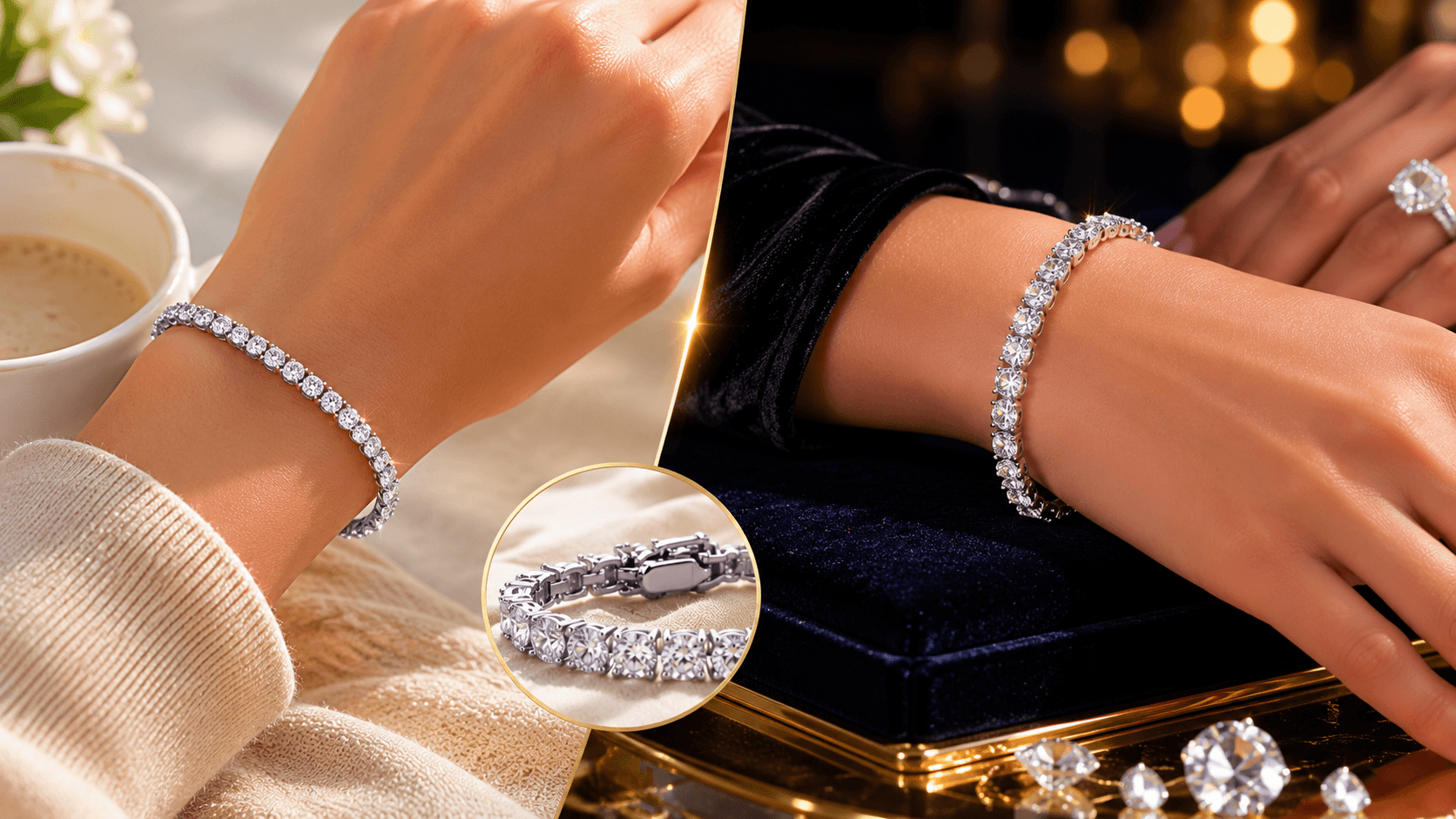
Box Clasp With Double Safety
A box clasp combined with two safety latches is one of the most common configurations for substantial tennis bracelets.
It includes:
- The main internal box lock
- A safety catch on one side
- A second safety catch on the other side
Each part has a separate purpose.
The box holds the bracelet closed during normal wear.
The side latches provide backup support.
Daily Closing Sequence
A practical sequence is:
- Align both ends.
- Insert the tongue straight into the box.
- Confirm positive locking.
- Close the first side safety.
- Close the second side safety.
- Pull very gently to confirm closure.
- Inspect the clasp visually.
Do not test the bracelet by pulling hard.
The purpose is only to confirm that the clasp is properly engaged.
Which Clasp Is the Most Secure?
There is no clasp that can guarantee a bracelet will never open or become damaged.
Security depends on:
- Clasp construction
- Metal quality
- Correct alignment
- Bracelet weight
- Secondary safety
- Wear and maintenance
- Proper fastening
- Daily activity
- Professional inspection
A well-made box or tongue-and-groove clasp with functioning side safeties is commonly used because it combines a main lock with secondary protection.
However, even a strong clasp can become less reliable if it is worn, bent, dirty or incorrectly closed.
Clasp Size and Bracelet Weight

The clasp should be proportionate to the bracelet.
A very fine clasp may not feel suitable for a heavy bracelet with large diamonds.
A very large clasp may:
- Feel uncomfortable
- Rotate underneath the wrist
- Interrupt the diamond line
- Add excessive rigid length
- Make a fine bracelet look unbalanced
Clasp selection should consider:
- Total bracelet weight
- Diamond size
- Link width
- Metal thickness
- Bracelet length
- Wrist size
- Intended frequency of wear
Clasp Balance
A heavy clasp may naturally settle under the wrist.
This is not always a defect.
However, poor balance may cause:
- Constant rotation
- Diamonds moving underneath the wrist
- Discomfort
- Excessive pressure at one point
- Repeated contact with desks or surfaces
Correct bracelet sizing can help control rotation.
A bracelet that is excessively loose gives the clasp more freedom to move.
Clasp and Bracelet Length
The clasp forms part of the bracelet’s total length.
Its rigid structure may also affect fit differently from flexible diamond links.
Two bracelets with the same listed length may feel different when:
- One has a long box clasp
- One has a small integrated clasp
- One uses an extension chain
- One has broad safety latches
- One has larger diamond links
Before ordering, confirm whether the stated length includes the complete clasp.
Clasp and Wrist Comfort
The clasp normally sits on the underside or side of the wrist.
It should not:
- Press sharply into the skin
- Contain rough edges
- Catch body hair
- Restrict wrist movement
- Create a painful pressure point
- Open during ordinary motion
- Feel significantly heavier than the bracelet
Try the bracelet for several minutes and move the wrist naturally.
A clasp may feel comfortable initially but become noticeable after typing, driving or resting the wrist on a surface.
One-Handed Fastening
Tennis bracelets often need to be closed with one hand.
Some clasps are easier to operate than others.
Consider:
- Button size
- Tongue alignment
- Safety-latch stiffness
- Bracelet flexibility
- Dominant hand
- Nail length
- Hand mobility
- Visibility of the clasp
A secure clasp should not be selected only because it is easy to open.
Ease of operation and resistance to accidental opening must be balanced.
A jeweller should demonstrate the correct technique.
Left-Handed and Right-Handed Use
The clasp may feel easier or harder depending on which wrist receives the bracelet.
A right-handed wearer fastening a bracelet on the left wrist may have a different experience from fastening it on the right.
Before finalising, test:
- The intended wrist
- The main release
- Both safety catches
- Whether the clasp can be seen
- Whether the wearer can operate it comfortably
Some clasp orientations can be adjusted during production or alteration.
Clasp Security Check Before Each Wear

A short routine can reduce the risk of wearing a bracelet with an incompletely closed clasp.
Before wearing:
- Check that the tongue is straight
- Inspect the box opening
- Confirm safety latches are not bent
- Close the main clasp fully
- Close every secondary safety
- Test with a gentle pull
- Confirm the bracelet is not twisted
- Check that the clasp sits flat
If the clasp does not feel normal, do not rely on it.
Have it professionally inspected.
Signs of a Properly Working Clasp
A functioning clasp should normally:
- Align easily
- Close with positive engagement
- Remain closed during a gentle test
- Open only when the release is operated
- Keep safety latches secure
- Sit flush with the bracelet
- Avoid visible gaps
- Feel consistent each time
- Show no obvious bending
Any sudden change in operation deserves attention.
Warning Signs of Clasp Wear
Seek professional inspection if:
- The clasp opens too easily
- The tongue slides out without release
- Buttons feel loose
- The closure does not click or engage
- Side safeties lift repeatedly
- The tongue is bent
- The box appears widened
- The clasp sits at an angle
- Metal shows cracks
- The bracelet opens during wear
- The safety catch no longer reaches its post
- The mechanism feels rough
- The clasp requires unusual force
Do not continue wearing the bracelet because the secondary latch still works.
The main clasp should also be repaired.
Loose Clasp Versus Tight Clasp
A loose clasp may fail to engage correctly.
A very tight clasp may indicate:
- Misalignment
- Dirt inside the mechanism
- A bent tongue
- A damaged box
- Incorrect previous adjustment
- Metal distortion
A clasp should feel firm, not forced.
Repeatedly forcing a tight mechanism can cause further damage.
Cleaning Around the Clasp
Dirt, lotion, soap and fine debris can collect inside the clasp.
This may affect:
- Button movement
- Tongue insertion
- Safety-latch closure
- Internal spring action
- Visual inspection
Use only appropriate gentle cleaning methods.
Avoid inserting sharp objects into the clasp.
Professional cleaning can remove debris while allowing the jeweller to inspect the mechanism.
For broader maintenance instructions, read the guide on how to clean and maintain diamond jewellery.
Can Water Affect a Clasp?
Ordinary clean water may not immediately damage a properly constructed gold clasp, but wearing the bracelet during bathing or swimming can create additional risks.
These include:
- Soap residue
- Chlorine exposure
- Saltwater exposure
- Reduced grip
- Bracelet slipping
- Contact with hard surfaces
- Difficulty noticing an open clasp
- Accumulation inside the mechanism
Remove the bracelet before swimming, showering or activities where it may be lost.
Clasp Inspection After Impact
A bracelet should be checked after:
- Being dropped
- Catching on clothing
- Strong pulling
- Hitting a hard surface
- Being trapped under an object
- Opening unexpectedly
- Twisting sharply
Even when the clasp still closes, impact may affect alignment or internal tension.
Also inspect nearby links because force can travel through the bracelet.
Professional Clasp Inspection
A professional inspection may include:
- Testing the main lock
- Checking tongue tension
- Examining the box
- Testing push buttons
- Inspecting hinges
- Checking figure-eight safeties
- Examining side posts
- Reviewing solder joints
- Checking link alignment
- Cleaning the mechanism
Inspection frequency depends on how often the bracelet is worn.
A frequently worn bracelet may require more regular checks than one reserved for occasional use.
Clasp Repair
Possible clasp repairs may include:
- Adjusting tongue tension
- Realigning the box
- Repairing a safety catch
- Replacing a worn hinge
- Rebuilding a post
- Replacing the clasp
- Soldering a connection
- Replacing a button or spring
- Refinishing the metal
The correct repair depends on the mechanism and extent of wear.
A temporary bend or squeeze should not be treated as a long-term repair for a valuable diamond bracelet.
Clasp Replacement
A clasp may need replacement when:
- The internal mechanism is heavily worn
- Metal has become too thin
- Cracks are visible
- Repeated repairs no longer hold
- The closure is unsuitable for bracelet weight
- Replacement parts cannot be matched
- The buyer needs a more practical mechanism
A replacement clasp should match:
- Metal colour
- Gold purity
- Bracelet width
- Link dimensions
- Weight
- Surface finish
- Safety requirements
The new clasp should not create an obvious weak point between old and new sections.
Altering the Bracelet Length
Removing or adding links can change the clasp position and balance.
After alteration, confirm:
- The clasp remains centred appropriately
- The bracelet is not twisted
- Links move freely
- The closure aligns correctly
- Safety catches still operate
- Diamond spacing remains consistent
- Bracelet length suits the wrist
A poorly balanced altered bracelet may rotate more than it did previously.
Clasp Safety for Daily Wear
For daily use, consider a clasp that:
- Has positive mechanical locking
- Includes a secondary safety
- Sits comfortably
- Can be operated correctly
- Matches the bracelet’s weight
- Can be inspected easily
- Does not catch frequently
The wearer should still remove the bracelet during:
- Exercise
- Heavy lifting
- Housework
- Manual work
- Swimming
- Sleeping
- Contact sports
- Activities involving machinery
No clasp should be expected to compensate for unsuitable wear conditions.
Clasp Safety for Occasional Wear
A bracelet worn only for events still needs inspection.
Long periods in storage can allow:
- Dust accumulation
- Tarnish on some components
- Stiff movement
- Forgotten damage
- Loose safety catches
Test the clasp before each occasion, especially when the bracelet has not been worn for several months.
Clasp and Clothing
A protruding safety catch or rough edge may catch:
- Lace
- Knitwear
- Silk
- Embroidery
- Loose sleeves
- Fine threads
Check the clasp surface by running a soft cloth gently over it.
If the cloth catches, the clasp may have a sharp edge or raised component requiring attention.
Do not file or smooth it at home.
Clasp and Bracelet Stacking
When a tennis bracelet is worn beside a watch or another bracelet, the clasp may receive repeated contact.
This can cause:
- Scratching
- Safety-latch movement
- Button pressure
- Hinge wear
- Rotation
- Noise
- Discomfort
Correct sizing can reduce uncontrolled movement.
Avoid placing a delicate clasp directly against a hard watch edge.
Clasp and Diamond Settings
The clasp should be inspected together with the first links on each side.
These areas may experience additional stress when:
- The bracelet is opened
- It is pulled during fastening
- The clasp rotates
- The bracelet catches
- The wearer removes it quickly
Check that the diamonds nearest the clasp remain secure and aligned.
Buying a Tennis Bracelet Online

When comparing bracelets online, request or review:
- Clasp type
- Close-up photographs
- Side safety details
- Opening and closing video
- Metal and purity
- Bracelet length
- Clasp length
- Bracelet weight
- Return conditions
- Resizing options
- After-sales inspection
A product image showing only the diamonds may not provide enough information about the clasp.
The general diamond tennis bracelet buying guide for Dubai covers additional considerations such as diamond quality, setting construction and bracelet fit.
Questions to Ask Before Buying
Ask the jeweller:
Tennis Bracelet Clasp Checklist
Before completing the purchase, confirm that:
Frequently Asked Questions
What is the most common tennis bracelet clasp?
A box or tongue-and-groove clasp with one or two side safety catches is commonly used because it combines a main lock with secondary protection.
What is a box clasp?
A box clasp uses a tongue that slides into a receiving box and locks internally.
It may also include side safety latches.
What is a figure-eight safety clasp?
A figure-eight safety is a small secondary loop that closes over a post beside the main clasp.
It provides additional support if the primary mechanism begins to open.
Are two safety latches better than one?
Two latches provide additional redundancy, but both must function and close correctly.
The main clasp should also remain secure.
Should a tennis bracelet clasp click?
Many box and tongue-style clasps produce a noticeable sound or feeling when they engage.
The expected action depends on the specific design.
Can a tennis bracelet open accidentally?
Any clasp can become less reliable if it is worn, damaged, dirty or incompletely closed.
Regular checks and professional inspection reduce the risk.
Is a lobster clasp suitable for a tennis bracelet?
It may be used on lighter or adjustable designs.
For a substantial diamond bracelet, buyers should check whether it is proportionate and whether the connecting ring is secure.
Are magnetic clasps safe for diamond bracelets?
A magnetic clasp should be assessed carefully.
For a valuable tennis bracelet, an additional mechanical safety is preferable rather than relying only on magnetic force.
How do I know when the clasp needs repair?
Warning signs include easy opening, poor alignment, loose buttons, bent safeties, visible gaps or a clasp that operates differently from usual.
Can I tighten a clasp at home?
Home bending or squeezing may weaken or misalign the metal.
A professional jeweller should inspect and adjust the mechanism.
How often should the clasp be checked?
The frequency depends on wear.
A bracelet worn regularly should be inspected more often than one worn occasionally, and it should always be checked after impact or unexpected opening.
Final Thoughts
Understanding tennis bracelet clasp types is essential when comparing diamond bracelets for regular or occasional wear.
A box or tongue-and-groove clasp provides a compact main closure and is often supported by one or two side safety latches. Push-button designs can make controlled opening easier, while figure-eight safeties provide a visible secondary connection.
Lobster, fold-over and concealed clasps may also be used depending on the bracelet’s construction. The correct closure should be proportionate to the bracelet’s weight, comfortable against the wrist and easy for the wearer to operate correctly.
No clasp should be considered maintenance-free.
The tongue, box, buttons, hinges and safety catches can all wear over time. A clasp that becomes loose, misaligned or unusually difficult to operate should be inspected before the bracelet is worn again.
Buyers should close the main mechanism and every secondary safety each time the bracelet is worn. The clasp should then be checked with a gentle pull and visual inspection.
At Laxmi Jewellers, buyers can explore the current bracelet collection and compare clasp construction, diamond settings and bracelet lengths in Dubai. Choosing a well-proportioned clasp and maintaining it properly can help the bracelet remain secure, comfortable and suitable for long-term wear.
Compare tennis bracelet clasps before choosing your design
Explore clasp construction, bracelet fit, diamond settings and after-sales inspection support for secure long-term wear.
