

Gold buying guide · Laxmi Jewellers Dubai
Gold Purity Marks Explained: 18K, 14K, 22K, 750, 585 and 916
Learn how karat and fineness numbers relate, why 14K may appear as 583 or 585, and how to treat a gold mark as one part of a careful buying check—not proof on its own.
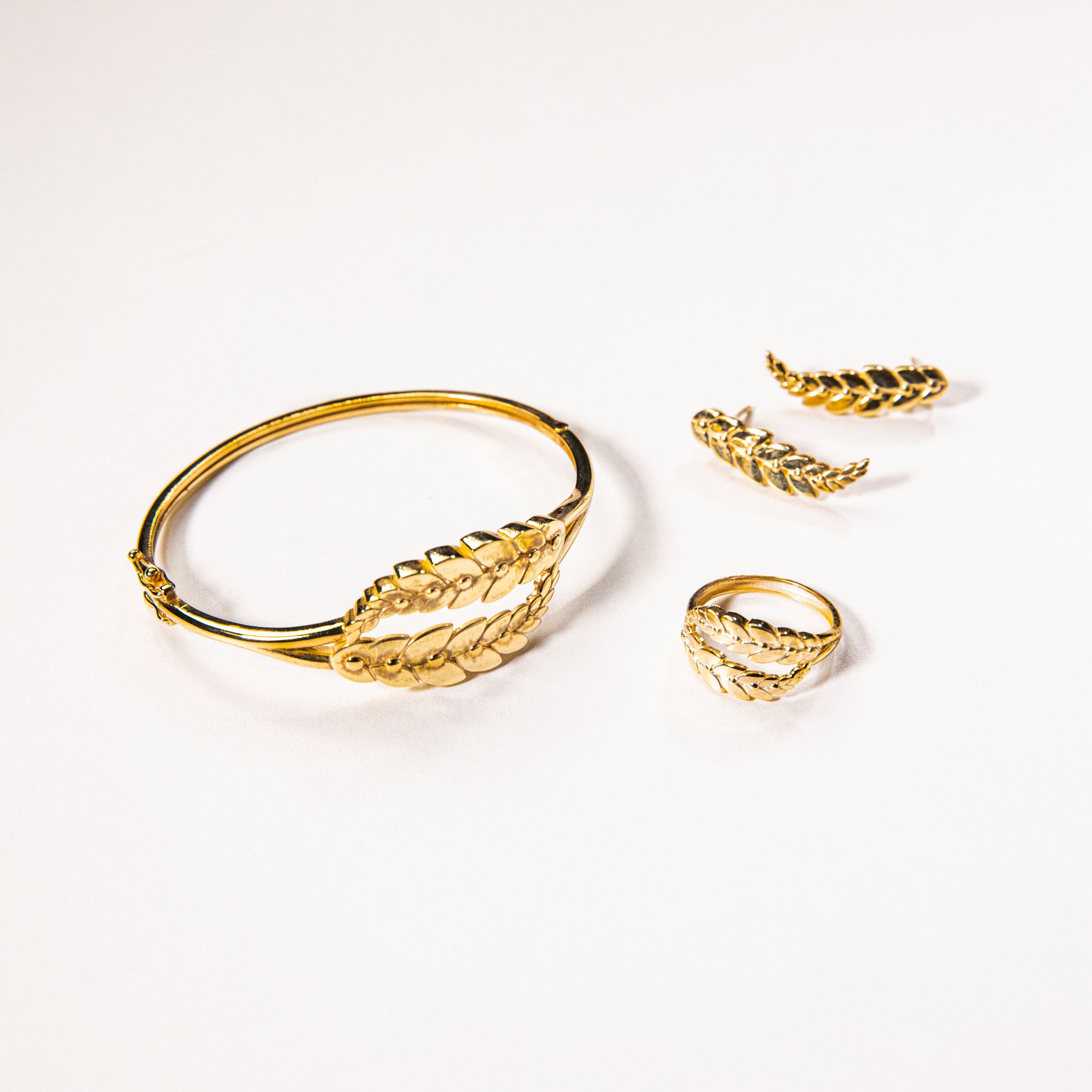
Gold purity marks describe a stated proportion of gold in a jewellery alloy. A karat mark expresses that proportion in twenty-fourths, while a three-digit fineness number expresses parts of gold per thousand. That makes 18K and 750 two ways of describing 75% gold, and 22K and 916 closely related ways of describing a little over 91.6% gold. The 14K line needs more context: 14 parts out of 24 calculate to about 583.3 per thousand, while 585 is also widely used internationally as a practical 14K-class fineness.
Read the mark as a specification to investigate, not a complete authentication result. Match it to the invoice or product description, look for the complete set of required marks, and buy from a seller who can explain the item and its documentation. A tiny “750”, “585” or “916” struck into metal can be useful, but the number alone cannot tell you who applied it, whether the whole piece matches it, or whether the item has been independently tested.
What 18K, 14K, 22K, 750, 585 and 916 mean
Pure gold is described as 24 karat. Jewellery is usually an alloy: gold is combined with other metals so that a maker can achieve the required working properties, appearance and finish. The karat number gives the nominal gold share out of 24. Fineness gives the nominal gold share out of 1,000.
| Mark | How to read it | Approximate gold proportion | Important context |
|---|---|---|---|
| 22K / 916 | 22 of 24 parts gold; 916 parts per thousand | About 91.6–91.7% | The UAE legal schedule lists 22 karat as 916 fineness. |
| 18K / 750 | 18 of 24 parts gold; 750 parts per thousand | 75% | These two expressions align directly. |
| 14K / 583 | 14 of 24 parts gold; 583 parts per thousand | About 58.3% | The UAE legal schedule lists 14 karat as 583 fineness. |
| 14K / 585 | A commonly used international 14K-class fineness mark | 58.5% | It is slightly above the exact 14/24 calculation; local marking rules still matter. |
The small difference between 583 and 585 is not a contradiction. Fourteen divided by twenty-four is 0.5833 recurring, which naturally leads to 583 when expressed to the nearest whole part per thousand. The World Gold Council notes that 585 is commonly used because manufacturers often work slightly above the exact 14K threshold. For UAE context, however, Federal Law No. 11 of 2015 lists 583 for 14 karat in its schedule of recognised gold standards. When comparing an imported piece with a locally marked item, record the exact mark rather than silently changing one number into the other.
Karat is not diamond carat
Karat: gold proportion
K or kt beside a gold number normally describes the proportion of gold in an alloy. An 18K gold ring is nominally eighteen parts gold out of twenty-four.
Carat: gemstone mass
ct beside a diamond or gemstone number describes mass. One metric carat is 0.2 gram. It does not state the purity of the surrounding gold.
A product listing can therefore contain both measures: for example, an 18K gold ring with a diamond whose weight is stated in carats. Keep each number attached to its noun when comparing pieces. “18K” belongs to the metal specification; “0.50 ct”, for example, belongs to the gemstone weight. The spelling difference between “karat” and “carat” helps in English, but abbreviations and international descriptions vary, so the surrounding product information remains essential.
A fineness number is not the whole official hallmark
The UAE precious-metals framework distinguishes between fineness standards, hallmarking and the responsibilities attached to trading precious-metal articles. In practical buyer language, that means “750” is the fineness part of the story, not necessarily the complete mark set or the complete evidence for a sale.
Marks are small, and their placement differs with construction. They may be found inside a ring, near a clasp, on a pendant bail or on another area that can accept a stamp without spoiling the visible design. Very small, delicate or unusually constructed pieces can require professional handling to inspect safely. Do not scrape, file or bend jewellery at home merely to expose a mark.
When shopping in the UAE, ask the seller to identify the fineness, show you where the relevant marks are located, and put the metal specification clearly on the sales documentation. For a starting point across current designs, you can browse Laxmi Jewellers’ shop and compare each product’s stated metal details rather than judging from colour alone.
What a purity mark can—and cannot—tell you
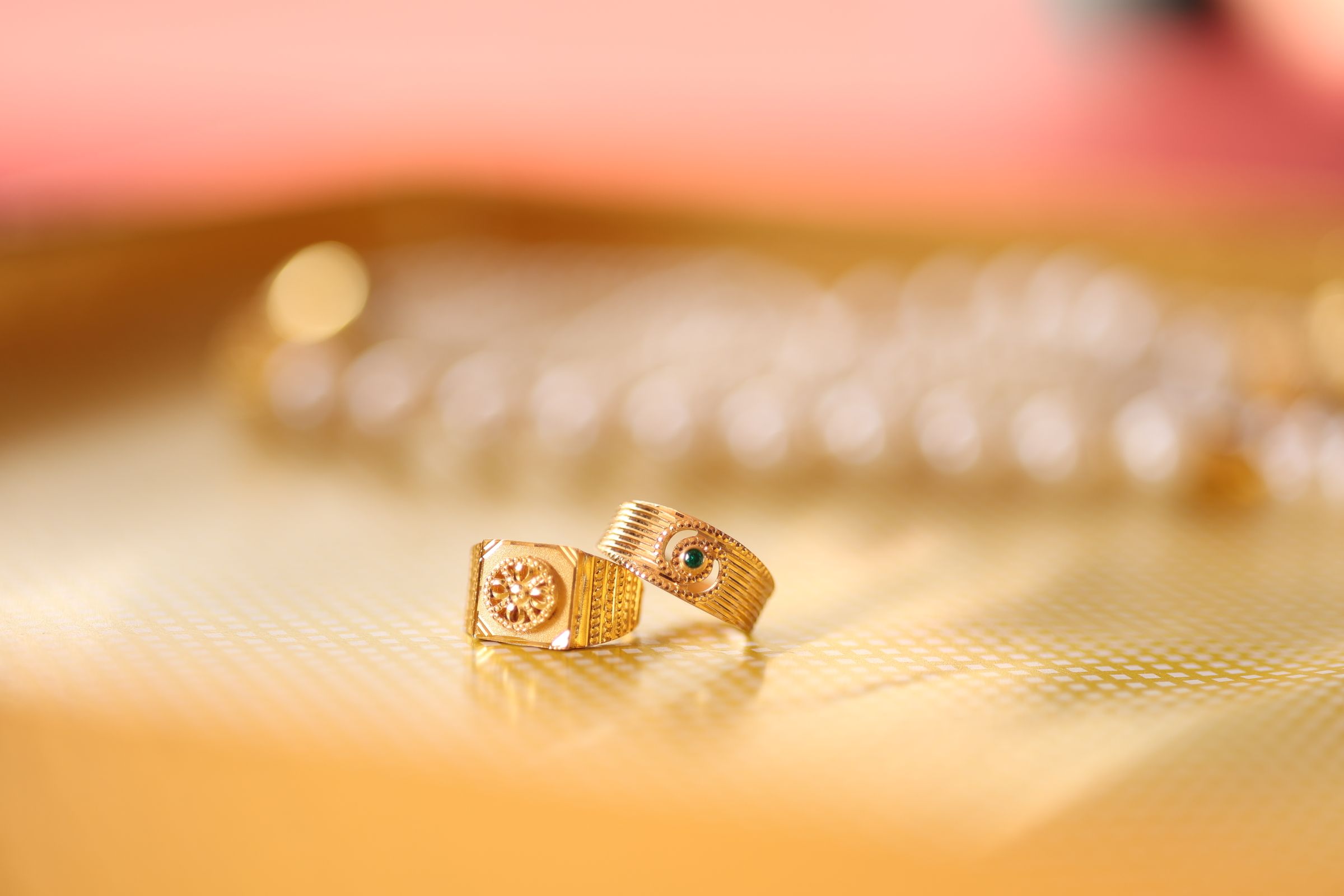
A legible mark gives you a claimed standard to check. It can help you compare the piece with its label, receipt and seller explanation. It can also give a trained professional a useful place to begin an examination. It cannot, on its own, authenticate an unknown item.
A mark can help you
- identify the stated karat or fineness;
- spot a mismatch between the item and its paperwork;
- record a precise description for service or insurance discussions; and
- ask a focused question before purchase.
A mark alone cannot prove
- that the stamp was applied by an authorised body;
- that every component has the same composition;
- that plating, solder, repairs or replacement parts are absent; or
- that the piece has a particular value, age or origin.
Professional gold-content work can use different methods depending on the question, the object and the required certainty. GIA’s technical review discusses approaches ranging from touchstone testing and instrumental analysis to fire assay, each with limitations and sampling considerations. That is why a responsible verification result should identify the method and scope rather than treating a visual glance at a stamp as a laboratory conclusion.
Why two 18K pieces may not behave or look identical
Fineness tells you how much gold is present, not the complete recipe for the remaining alloy. At 18K, 750 parts per thousand are gold; the other 250 parts can be balanced in different ways. Manufacturers select alloy systems and production methods for casting, fabrication, colour, finishing and the needs of a particular design. Two pieces can therefore share a 750 mark while differing in shade, feel, surface response or maintenance history.
This is also why colour is not a reliable purity test. Yellow, white and rose appearances are influenced by the non-gold portion and by finishing choices. If you want the design context without confusing it with fineness, see the separate guides to white gold and yellow gold engagement rings, mixed-metal jewellery styling, and rhodium plating for white gold. Those visual and care topics should not be used to infer a fineness number.
Construction matters too. Clasps, springs, soldered joints and repaired areas may involve engineering choices that a single headline description cannot fully explain. If uniform composition is important for your use case, ask the seller exactly what the stated fineness covers. Avoid assuming that every microscopic component can be interpreted from one visible stamp.
A sensible five-step purity check
- Read the full product description. Note the stated karat or fineness, metal colour, gemstones, approximate dimensions and any construction details supplied.
- Ask to see the mark. Let the seller point it out under suitable magnification. Record every character, not just the familiar three-digit number.
- Match item and documentation. The mark, invoice and verbal explanation should not conflict. Ask for clarification before payment if 14K, 583 and 585 are being used interchangeably without context.
- Consider the complete piece. Check workmanship, fit, joints, fastening and condition separately from purity. When comparing rings, for example, a fineness mark cannot tell you whether the size or setting suits your routine.
- Escalate uncertainty appropriately. For an heirloom, second-hand piece, altered item or unclear stamp, seek an independent qualified assessment. Ask what was tested, where it was tested and which method supported the conclusion.
Pause when a seller discourages basic documentation questions, when a mark looks incomplete or inconsistent with the description, or when a claim relies entirely on colour. These signals do not automatically prove a problem, but they are good reasons to slow down and request clearer evidence.
Three examples of careful interpretation
“750” inside a ring: read it as a claim of 750 parts gold per thousand, equivalent to 18K. Then check the rest of the mark set and the sales description. Do not use the number alone to conclude who made the ring or what it is worth.
“916” on a yellow-gold piece: read it as 916 parts gold per thousand, corresponding to the UAE schedule’s 22K standard. Its yellow appearance is compatible with many high-gold alloys, but colour is not the verification method.
“585” on an imported 14K item: recognise it as a common international 14K-class mark. Also recognise the local nuance: the UAE legal schedule lists 583 for 14K. Ask the seller how the item was marked, tested and documented rather than treating either number as a complete hallmark by itself.
Gold purity mark FAQ
Is 750 gold the same as 18K gold?
As a fineness statement, yes: 750 parts per thousand equals 75% gold, and 18 parts out of 24 also equals 75%. You should still verify that the mark belongs to the item and agrees with its complete documentation.
Is 916 the same as 22K?
They are corresponding standards in common use. Twenty-two parts out of twenty-four equal about 91.67%, expressed as 916 parts per thousand in the UAE legal schedule.
Why do I see both 583 and 585 for 14K?
Exact 14/24 is about 583.3 parts per thousand, and the UAE schedule lists 583. The 585 mark is also widely used internationally for 14K-class jewellery made slightly above that exact proportion. Keep the market and complete marking context attached to the number.
Does a 750 stamp prove a piece is solid gold?
No. It is a stated fineness mark, not standalone proof of authenticity or a full description of construction. A plated, altered, repaired or falsely marked object cannot be ruled out merely by seeing three digits.
Can I test gold accurately at home?
Home observations may reveal an obvious mismatch, but reliable gold-content determination requires an appropriate method and competent interpretation. DIY scratching, acid or filing can damage jewellery and may still give an incomplete answer.
Does a higher karat always last longer?
No universal durability ranking follows from karat alone. Wear depends on the complete alloy, design, thickness, construction, finish, use and care. Compare the whole item for the way you intend to wear it.
Authoritative sources
- World Gold Council: About gold jewellery
- GIA: Methods for Determining the Gold Content of Jewelry Metals
- UAE Federal Law No. 11 of 2015 on the Control of Trading in Precious Stones and Precious Metals and their Hallmarking
- UAE Ministry of Industry and Advanced Technology: implementing regulation document
This guide is educational and does not replace item-specific testing, the seller’s documentation or advice from an authorised UAE authority or qualified professional.
Compare gold jewellery with the details made clear
Review the stated fineness, design and product information together, then ask our team to show you the relevant marks and answer item-specific questions before you choose.
