

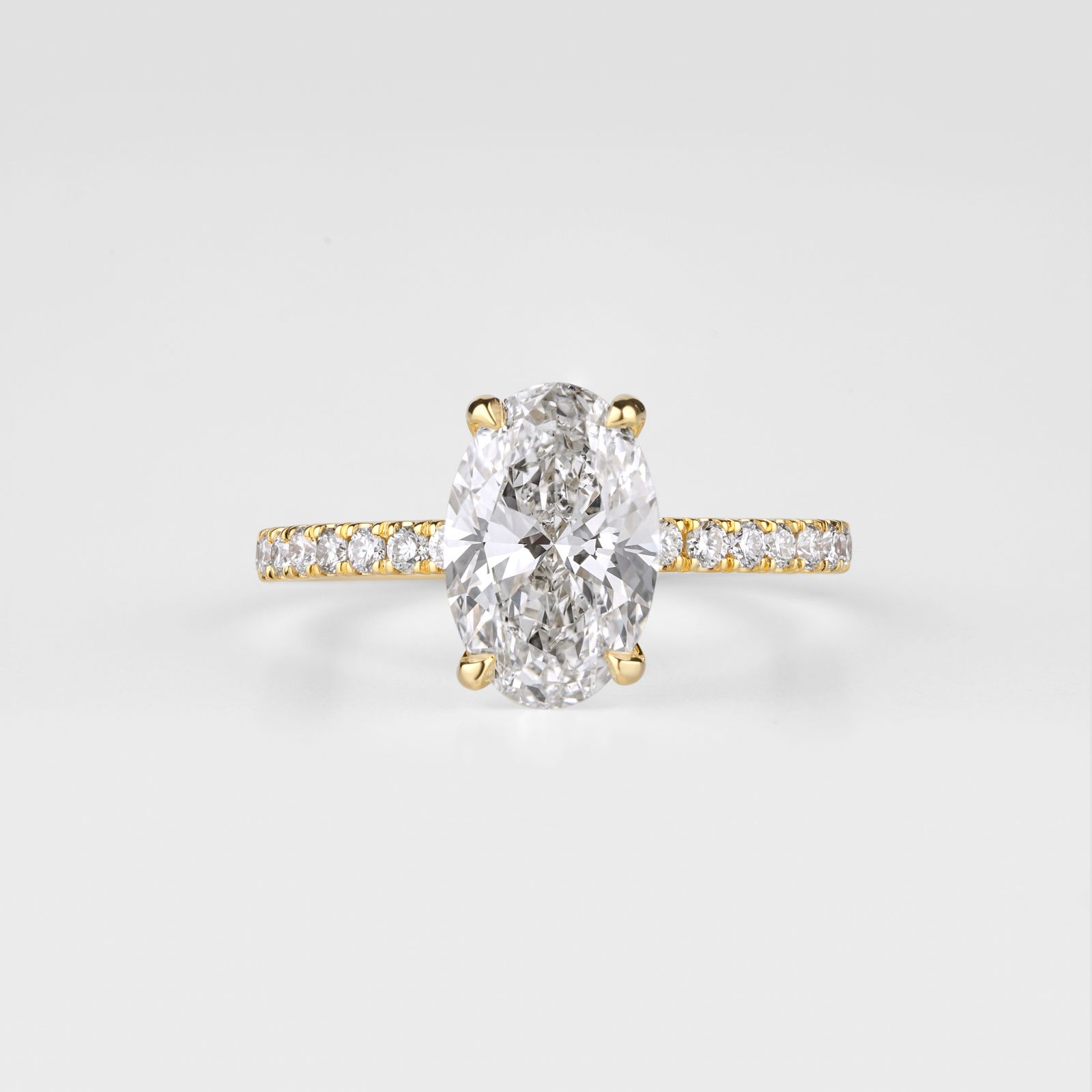
Diamond light performance
Diamond Bow-Tie Effect: What It Means in Oval, Pear, and Marquise Cuts
A dark band across an elongated diamond can be subtle and lively or broad and distracting. Learn what creates the pattern, why photographs do not tell the whole story, and how to assess it with confidence.
The quick answer
A Bow Tie Is a Light-and-Contrast Pattern, Not an Inclusion
The diamond bow-tie effect is a darker, bow-shaped area that can appear across the centre of elongated brilliant-style diamonds. It is most often discussed in oval, pear, and marquise shapes. A trace of contrast is common; the useful question is whether the pattern adds definition or suppresses too much brightness.
Diamonds do not look bright in every facet at the same instant. Their pattern depends on how the facets collect and return light, where the observer is standing and how the stone moves. In an elongated diamond, some central facets can return the reflection of the viewer or another blocked area rather than a bright part of the environment. The result may look like two dark triangles meeting across the middle.
This is different from an inclusion. An inclusion is an internal clarity characteristic. A bow tie is an appearance pattern created by the relationship between the diamond’s shape, facet arrangement, proportions, lighting, and viewing position. It can therefore change as the diamond or the observer moves.
How the pattern forms
Why Do Some Diamonds Show a Bow Tie?
A polished diamond behaves like a complex arrangement of small mirrors. Each facet receives light from part of the surrounding environment and directs some of it towards the eye. When the light source, diamond, and observer change position, the pattern of bright and dark reflections changes too. This shifting contrast is part of scintillation—the flashes seen when a diamond moves.
Elongated outlines distribute facets differently from a standard round brilliant. Across the wider central area, often called the belly, certain facet arrangements can channel the observer’s shadow into the face-up view. Your head and shoulders may block high-angle light, so the diamond returns a darker reflection through its centre.
The strength of that pattern can be influenced by several connected factors:
- Facet arrangement: the way the pavilion and crown facets are organised affects where light and contrast appear.
- Proportions: pavilion angles, depth, and the relationship between length and width can affect the pattern, although no single proportion predicts the complete appearance.
- Outline: long, narrow stones distribute reflections differently from fuller versions of the same shape.
- Viewing conditions: a stone may look darker under a small overhead light or when a camera is positioned very close to it.
- Movement: a transient shadow that brightens as the stone turns behaves differently from a dark area that remains fixed.
View it in motion
A Still Photograph Can Freeze the Darkest Moment
A single image records one combination of camera position and lighting. It may make a bow tie look stronger than it appears in ordinary wear, or hide a persistent dark band behind carefully placed studio lights.
Video is more informative because it shows whether the central pattern breaks into bright flashes as the diamond tilts. Even then, a video should move slowly enough to reveal the whole face of the stone. Very fast rotation and intense spot lighting can make every diamond look lively without showing how it behaves in calmer conditions.
When possible, compare the stone in diffused daylight, normal indoor light, and gentle directional light. Hold it at a natural viewing distance rather than placing it directly beneath the eye. The aim is to recreate the varied situations in which the jewellery will actually be seen.
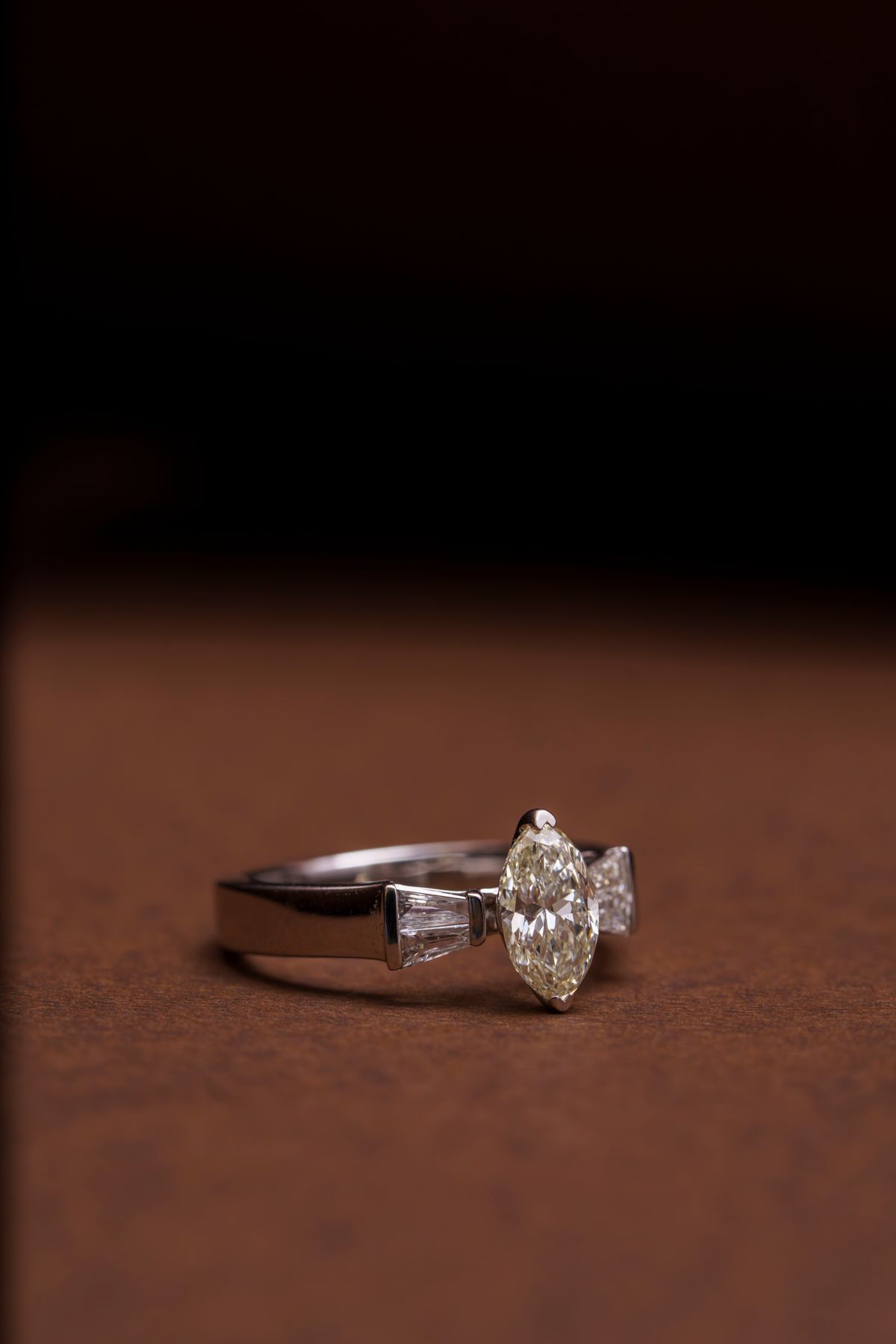
Visual judgement
When Is a Bow Tie Balanced—and When Is It Distracting?
There is no useful universal rule that says every visible bow tie is unacceptable. Personal preference matters, and a small amount of structured contrast can give an elongated diamond character. What deserves attention is the scale, darkness, and persistence of the pattern relative to the rest of the stone.
| What to observe | More balanced appearance | Potentially distracting appearance |
|---|---|---|
| Width | A narrow or broken band that leaves the centre lively. | A broad band occupying much of the stone’s middle. |
| Darkness | Soft grey contrast mixed with bright reflections. | A dense black area that overwhelms nearby facets. |
| Movement | The pattern brightens, separates, or flashes as the stone tilts. | The dark band remains prominent through a wide range of angles. |
| Symmetry | Contrast feels visually organised within the outline. | One side appears markedly darker or less lively than the other. |
| Overall impression | Your eye notices the complete shape and scintillation first. | Your eye repeatedly returns to a dark, static centre. |
Use these descriptions as observation prompts, not as remote grading criteria. Two people can look at the same subtle pattern and prefer different things. A sound decision comes from comparing several stones under consistent conditions and choosing the appearance that remains pleasing once the initial sparkle has settled.
Shape by shape
How the Effect Can Differ in Oval, Pear, and Marquise Diamonds
All three shapes are elongated, but their outlines place visual weight in different areas. That changes how a central contrast band relates to the complete silhouette.
Oval
An oval has two rounded ends and a broad central belly. A bow tie often reads as a horizontal band across that belly. Compare how evenly brightness reaches both ends and whether the centre remains active as the stone moves.
Pear
A pear combines a rounded end with a point. Check the bow tie alongside outline symmetry, brightness in the rounded lobe, and definition towards the tip. A balanced stone should feel coherent from end to end.
Marquise
A marquise has two pointed ends and an extended central section. The contrast band can appear particularly pronounced when it spans a narrow outline, so view the stone at ordinary distance and make sure both tips remain visually connected to the bright centre.
Radiant and some other elongated cuts may also show central dark patterns, but their mixed or “crushed-ice” facet appearance can make the visual assessment different. Compare like with like: an oval should be judged beside other ovals of similar proportions, rather than beside a round brilliant or a radiant cut with a different faceting style.
For a broader introduction to shape, proportion, and wearability, compare the characteristics of popular engagement-ring diamond shapes.
A practical viewing method
How to Assess a Diamond Bow Tie Before Choosing a Ring
You do not need specialist equipment to decide whether the pattern appeals to you. You do need consistent viewing conditions, a little time, and more than one comparison.
Start face-up at a natural distance
Look at the diamond as it would normally be seen on a hand. Avoid beginning with a loupe or a camera held only a few centimetres away, because close viewing can strengthen observer reflection.
Use calm, neutral lighting first
Diffused daylight or balanced indoor light reveals the overall pattern more clearly than intense jewellery-store spotlights. Add directional light later to observe flashes and fire.
Tilt the stone slowly
Move it from side to side and slightly forwards and backwards. Watch whether the central shadow changes into bright reflections or remains broad and dark through most positions.
Compare several stones consistently
Place similar shapes and approximate sizes in the same light. Side-by-side viewing helps the eye recognise differences that are difficult to judge in isolation.
Step back from the technical detail
After inspecting the centre, look at the complete diamond. Does the outline feel balanced? Is brightness distributed attractively? Does the pattern distract you without prompting?
Record your preference, not just a verdict
Avoid reducing the decision to “bow tie” or “no bow tie”. Note whether you prefer softer contrast, bolder contrast, or the most even brightness available within the shape.
Beyond the paperwork
Can a Grading Report or Setting Predict the Bow Tie?
A grading report is essential context, not a complete visual preview
A recognised grading report can document information such as shape, measurements, carat weight, colour, clarity, and finish characteristics. Those details help identify and compare diamonds. They do not replace seeing the stone, because the appeal of a complex contrast pattern depends on how multiple facets work together in real viewing conditions.
Proportions can help you ask better questions, but a single depth percentage or length-to-width ratio should not be treated as a guaranteed bow-tie test. Two diamonds with similar headline measurements can still show different face-up patterns.
A setting can change context, but it cannot recut the diamond
Metal colour, prong placement, a halo, and the visual width of the band can influence how the eye reads a diamond. They may frame the outline or alter contrast around its edge. They cannot correct an unattractive facet pattern within the stone. Choose the diamond for its own face-up appearance first, then choose a setting that supports its shape and protects vulnerable points.
Pear and marquise tips require appropriate protection, while every prong-set ring benefits from periodic checks. If you already own a daily-wear ring, learn when diamond-ring prongs should be inspected.
Buying or comparing remotely
What to Request When Viewing an Elongated Diamond Online
Online photography can be useful when it is transparent and consistent. Before making a decision, ask for enough material to understand both the diamond and the way it was recorded.
- A face-up video with slow, controlled movement
- Footage in diffused and ordinary indoor light
- A side view as well as the face-up view
- Images without a filter or heavy contrast edit
- The diamond’s measurements and grading details
- A comparison with one or two similar stones
- Confirmation of the stone shown in each video
- A view at realistic scale, not only macro magnification
Authoritative reading
Sources and Further Reading
The following gemmological references provide additional detail on elongated diamond appearance and bow-tie patterns:
Helpful answers
Frequently Asked Questions
Do all oval diamonds have a bow tie?
Many oval diamonds show some central contrast when viewed face-up, but the width, darkness, and persistence vary. A subtle pattern that changes with movement can look very different from a broad, static dark band.
Is a bow tie an inclusion or clarity flaw?
No. It is a pattern of light and dark reflections associated with facet arrangement, proportions, viewing position, and lighting. An inclusion is a separate internal clarity characteristic.
Can lab-grown diamonds show a bow-tie effect?
Yes. The effect relates to a polished diamond’s shape and cutting pattern, not whether the diamond formed underground or in a laboratory.
Can a jewellery setting remove a bow tie?
No setting can change the diamond’s facet arrangement. A setting can influence the visual context around the stone, but a distracting central pattern should be assessed before the diamond is set.
Should a diamond have no dark areas at all?
Not necessarily. Balanced contrast helps create definition and scintillation. The concern is not every dark reflection; it is a dark area that is wide, dominant, or persistent enough to reduce the stone’s overall liveliness.
Why does the bow tie look stronger in a phone photo?
The camera or the person holding it may block part of the available light, especially at close range. Exposure, contrast processing, and a single frozen angle can also make the centre look darker than it does in motion.
Can measurements alone identify the best oval or pear diamond?
Measurements and proportions are valuable comparison data, but they do not fully describe the face-up pattern. Use them together with clear images, slow video, and direct visual comparison where possible.
