

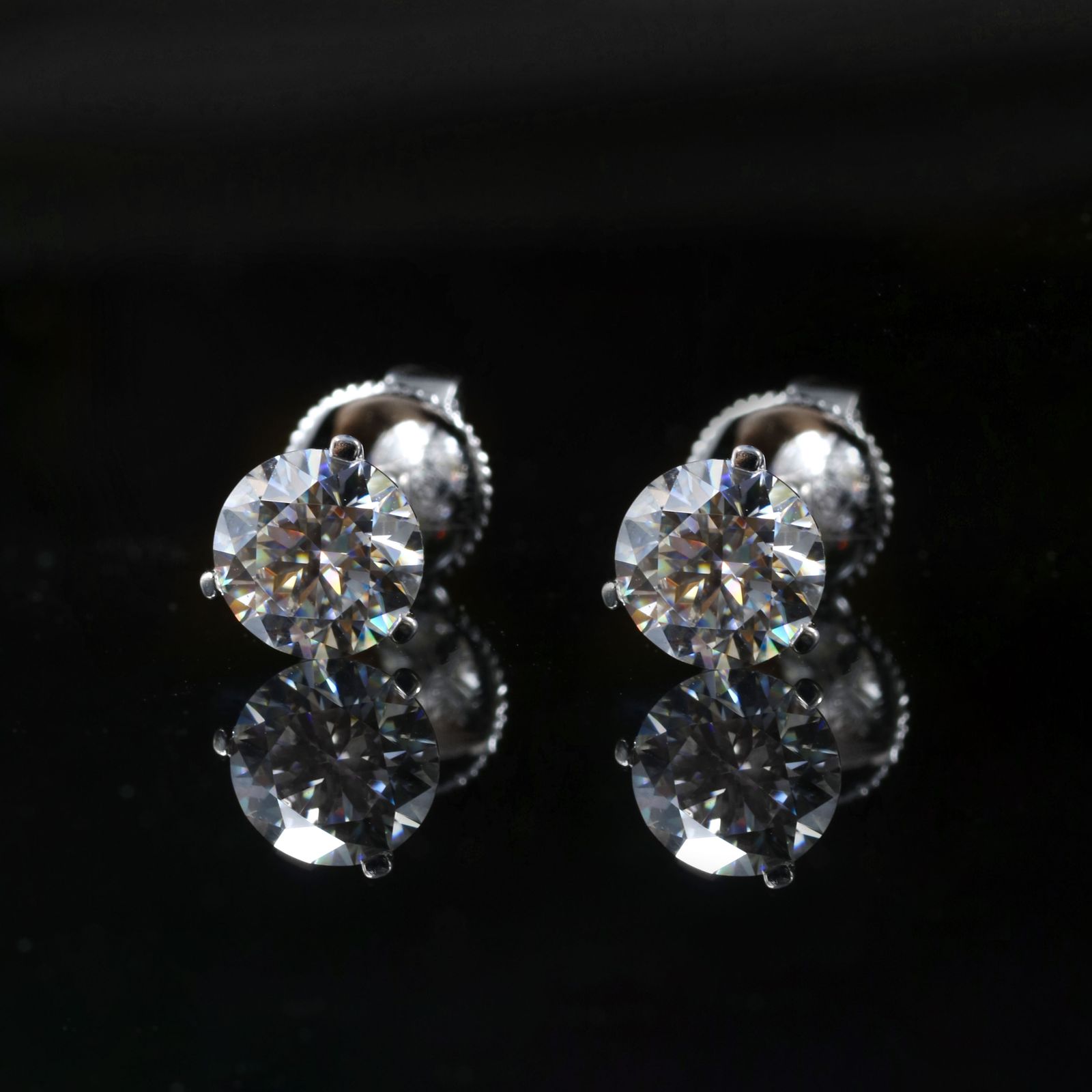
Diamond earring carat guide
Diamond Earring Carat Weight Explained: Per Pair vs Per Earring
A listing that says “1.00 carat” can describe the combined diamonds in a pair, one diamond in each ear, or the combined weight of all centre and accent stones in a more detailed design. Here is how to read the number before you compare.
For a simple, matched pair of single-diamond studs, a stated total carat weight normally covers both earrings. Therefore, a 1.00 ct total pair would usually contain about 0.50 ct in each earring. The word total matters, however, and the calculation changes when an earring contains halos, clusters, or other accent diamonds.
If two equal diamonds are the only stones in the pair, divide the clearly stated total carat weight by two. If a listing does not say whether the weight is for the pair or for each earring, ask the jeweller to confirm in writing rather than assuming.
Carat is a measure of diamond weight, not a promise of visible diameter. It is also independent of origin: one carat means the same weight for a natural diamond and a laboratory-grown diamond. According to the Gemological Institute of America’s carat explanation, one metric carat equals 200 milligrams and is divided into 100 points.
Read the label first
What ct, ctw, and “each” usually mean
Jewellery listings do not all present weight in the same format. Some state the weight of each main diamond and the pair total. Others display one headline number and explain it in the specifications. The following terms are common, but the product description remains the deciding source.
A unit of weight. Beside one diamond, it may refer to that individual stone. In an earring title, context is essential.
Usually the combined weight of the diamonds covered by the listing—often both earrings and, where relevant, their accent stones.
An explicit per-diamond or per-ear figure. A pair marked “0.50 ct each, 1.00 ct total” removes the arithmetic ambiguity.
The term “pair weight” can also mean the sum of all diamonds across both earrings. With classic solitaire studs, that sum is easy to understand. With floral, halo, cluster, or drop designs, the headline figure can combine many stones of different sizes.
Simple studs
How to calculate carat weight per earring
For a symmetrical pair containing one similarly weighted diamond in each earring, the basic calculation is straightforward:
÷ 2
| Listing says | If there are two equal diamonds only | What to verify |
|---|---|---|
| 0.50 ct total | About 0.25 ct per diamond | That “total” covers the complete pair |
| 1.00 ct total | About 0.50 ct per diamond | Individual weights and millimetre measurements |
| 2.00 ct total | About 1.00 ct per diamond | That there are no accent diamonds in the total |
| 1.00 ct each / 2.00 ct total | About 1.00 ct per diamond | The wording is already explicit; compare dimensions and grading details |
These examples illustrate the arithmetic, not a guarantee that two diamonds will have exactly identical weights. A matched pair may have a small permitted difference while still looking balanced.
Do not divide automatically if the design contains more than two diamonds. For a halo stud, for example, “1.00 ct total” may include two centre stones plus every smaller halo stone across both ears. The centre-diamond weight is then less than 0.50 ct each unless the listing states otherwise.
The number is not the silhouette
Why equal carat weight can look different on the ear
Carat tells you how much a diamond weighs; it does not tell you how that weight is distributed. Two diamonds with the same carat weight can have different face-up dimensions because their proportions, shape, and cut differ. A stone carrying more weight in its depth may present a smaller outline than another stone of equal weight.
Setting style changes the visual impression too. A fine bezel can create a continuous outline around a diamond, while prongs expose more of its edge. A halo adds visible spread through smaller surrounding diamonds. None of these effects changes the centre diamond’s actual carat weight.
For round studs, ask for the diameter in millimetres. For oval, pear, emerald, and other fancy shapes, look for length and width. Then consider the measurements beside the carat figure rather than using weight alone as a size chart.
Halos, clusters, and drops
Centre weight versus accent and total weight
Multi-stone earrings need more than one number to describe them well. A centre-weight figure separates the principal diamonds from the accents, but it may describe each centre diamond or the two centres combined; the listing should state its basis. Accent weight covers the smaller diamonds used around or below the centres. Total carat weight combines the diamonds that the specification says are included, often across the complete pair.
Consider a hypothetical symmetrical pair described as 1.20 ct total. If the two centre diamonds weigh 0.40 ct each, they contribute 0.80 ct together. The remaining 0.40 ct may be divided among all accent diamonds across both earrings. The headline total is correct, but it does not mean each centre diamond weighs 0.60 ct.
| Specification | What it tells you | Why it matters |
|---|---|---|
| Centre weight | Weight of the principal diamond or diamonds | Separates the focal stones from supporting sparkle |
| Accent weight | Combined weight of smaller supporting diamonds | Explains how much of the total sits outside the centres |
| Total carat weight | Combined included diamond weight | Useful only when the included stones and pair/each basis are clear |
| Diamond count | Number of diamonds in the design | Helps you understand how widely the total is distributed |
This distinction is useful beyond studs. Hoops may quote the sum of every diamond across the pair, while drops may combine several graduated stones. Read the design’s stone breakdown before comparing its total with a solitaire pair.
Check each part of the pair
Carat figures, grading reports, and matched diamonds
A laboratory grading report describes the diamond submitted for examination; it should not be read as a report for the combined pair unless its scope explicitly says so. Where two principal diamonds are individually graded, each may have a separate report and report number. Add the individual weights to compare them with the declared pair total, then account for any accent diamonds separately.
Smaller accent diamonds are not necessarily supplied with individual grading reports. Their combined weight and stated quality range may appear in the jewellery specification instead. This is one reason a transparent stone breakdown is more useful than a headline total by itself.
Weight is only one part of matching a pair. The two focal diamonds should appear balanced face-up. Shape outline, millimetre dimensions, brightness, colour, and clarity can all influence whether the earrings look harmonious. Exact numeric identity is not always possible or visually necessary, but an obvious mismatch should be discussed before purchase.
Read the pair total
Find the precise phrase used: total, each, centre, accent, or a combination of these.
Count the diamonds
Confirm whether there are two solitaire diamonds or multiple stones contributing to the headline number.
Match reports to stones
Where reports are supplied, check which diamond each report describes and compare its weight with the product specification.
Compare dimensions visually
Use millimetre measurements and clear photos or video to assess face-up balance—not carat alone.
When shopping remotely, ask for the complete stone breakdown, face-up dimensions, report numbers where supplied, and clear images or video of both earrings before comparing two pairs.
A clearer comparison
Seven questions to ask before comparing diamond earrings
A useful listing should make it possible to distinguish the pair total from the size of its most important stones. Before comparing two designs, check:
- Is the quoted carat weight for the pair or each earring?
- Does the total include centre and accent diamonds?
- How many diamonds contribute to the stated total?
- What does each main diamond weigh?
- What are the face-up millimetre dimensions?
- Are grading reports supplied, and which stones do they cover?
- How closely are the principal diamonds matched?
Reliable references
Carat-weight sources
The fundamental definitions in this guide are supported by independent gemmological education resources:
- GIA: Diamond carat weight — the metric carat, points, and the relationship between weight and value.
- GIA: Understanding carat weight on diamond grading reports — individual weight, total carat weight, visible dimensions, and the difference between carat and karat.
- GIA: Nine things about diamond carat weight — why stones of equal weight can differ in visual size and quality.
- International Gemological Institute: Carat weight — carat measurement and how proportions affect appearance.
Frequently asked questions
Diamond earring carat weight FAQs
Do 1-carat diamond earrings mean 1 carat in each ear?
Not usually when the listing says 1.00 ct total for a simple pair. In that case, two similarly weighted diamonds would be about 0.50 ct each. If the title omits “total” or “each”, check the specification or ask the jeweller to confirm.
What does 2 ctw mean for diamond studs?
For two solitaire studs described as 2.00 ctw for the pair, it generally means about 1.00 ct per diamond. That interpretation depends on the total covering only those two diamonds, so verify the stone count and wording.
Is carat the same as the size in millimetres?
No. Carat measures weight. Millimetres describe face-up length, width, or diameter. Cut proportions and shape determine how the weight is distributed, so equal-carat diamonds can have different visible dimensions.
Does total carat weight include halo diamonds?
It often does when a listing uses total weight for the complete design, but terminology varies. Look for separate centre and accent weights. If they are not shown, ask exactly which diamonds the total includes.
Is carat measured differently for lab-grown diamonds?
No. The metric carat is the same unit for laboratory-grown and natural diamonds. Origin does not alter the weight calculation.
Do both stud diamonds need exactly the same carat weight?
They should look balanced, but a small weight difference can be visually insignificant. Face-up dimensions, shape outline, brightness, colour, and clarity also contribute to a well-matched pair.
Should each earring diamond have its own grading report?
Larger principal diamonds may be individually graded, in which case each report describes its corresponding stone. Small accent diamonds are not always individually reported. Ask what documentation is included and match report weights and numbers to the specification.
Is diamond carat the same as gold karat?
No. Carat measures the weight of a diamond or another gemstone. Karat, usually abbreviated as K, describes gold purity; for example, 18K gold contains 18 parts gold out of 24. The terms sound alike but measure different things.
Compare diamond studs with the numbers made clear
Review Laxmi Jewellers’ stud earrings, then confirm pair total, individual stone weight, and dimensions for the design you are considering.
