

Practical jewellery inspection · Laxmi Jewellers Dubai
How to Use a Jeweller’s Loupe: Focus, Lighting and What 10× Can Show
Build a steady viewing position, move the item through the loupe’s narrow focus, use light deliberately and understand where home observation must give way to trained assessment.
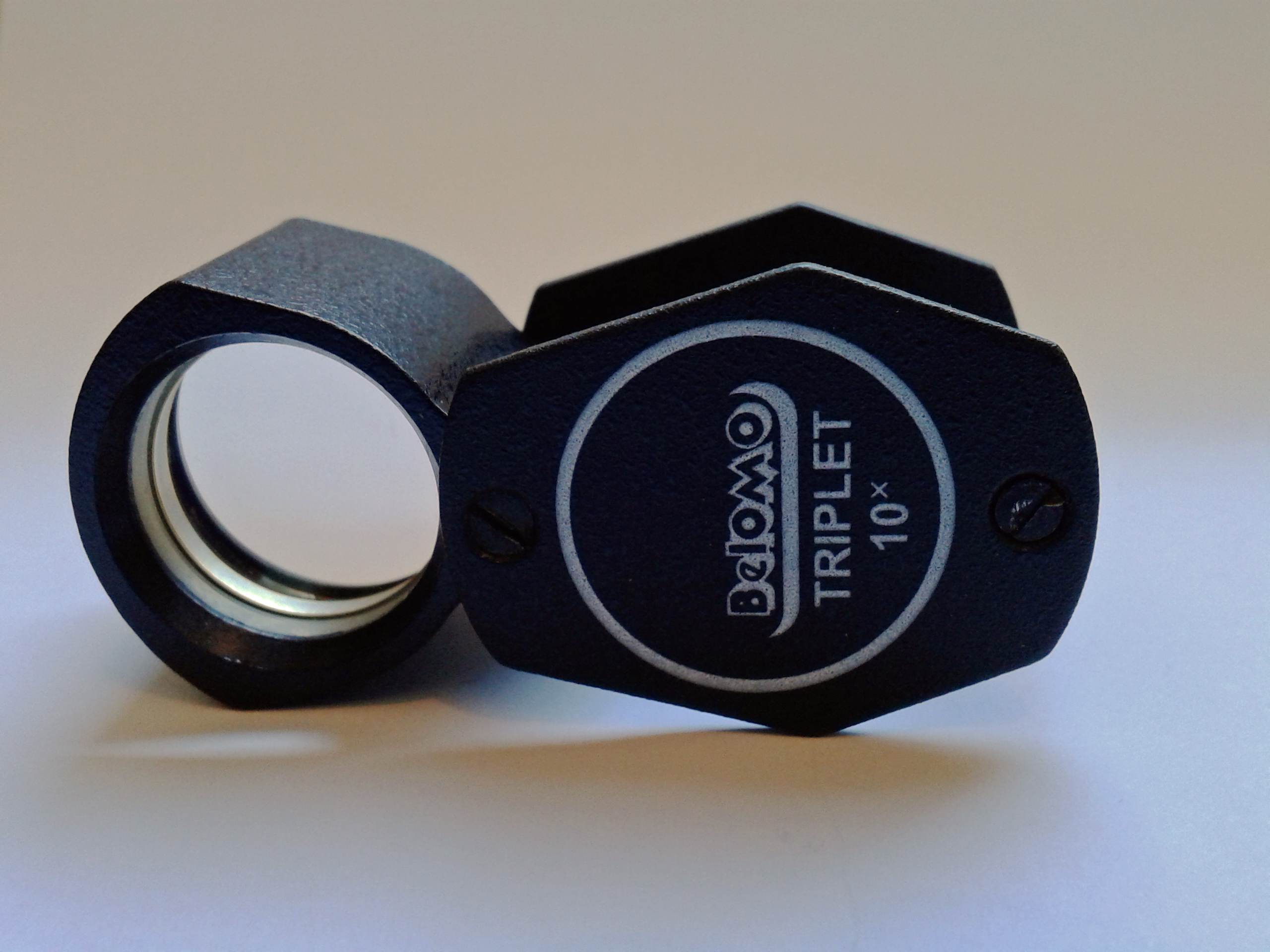
To use a jeweller’s loupe, hold the lens close to one eye, keep both eyes open if comfortable, brace the hand holding the loupe against your face and bring the jewellery towards the lens until one small area becomes sharp. Keep the loupe still, move the item rather than your head, and rotate it gradually under clean, even light. A 10× view can help you observe details; it cannot by itself authenticate a gem, issue a clarity grade or diagnose a repair.
Start with a clean, secure item and a standard 10× loupe. Establish focus on an easy edge, then scan in a repeatable order while changing the light angle. Record what you see in neutral words—location, shape, colour, surface or movement—without naming a material or assigning a grade. If the piece is valuable, loose, damaged or uncertain, stop handling it and ask a qualified professional to examine it with suitable instruments.
Why a corrected 10× loupe is the useful baseline
Ten-times magnification is the familiar gem and jewellery standard because it offers a practical balance of enlargement, field of view and working distance. More magnification is not automatically more useful: as power rises, the sharp area and working distance become smaller, lighting becomes harder and hand movement appears more dramatic.
A corrected triplet loupe uses a multi-element lens system intended to reduce colour fringing and edge distortion. That does not make every view perfect, but it makes the centre of the image more dependable than an uncorrected novelty lens. Check that the lens is clean, the folding housing opens smoothly and the marked magnification is clear. Avoid judging important details through a scratched or cloudy lens.
Clean the view, control the item and protect the setting
Fingerprints, lint and dried residue can look surprisingly prominent at 10×. Begin by checking the piece with the unaided eye and use only a cleaning method known to be safe for its complete construction. If the material, treatment, adhesive or setting is unknown, do not experiment. Laxmi’s jewellery cleaning and maintenance guide explains why the stone, metal and setting must be considered together.
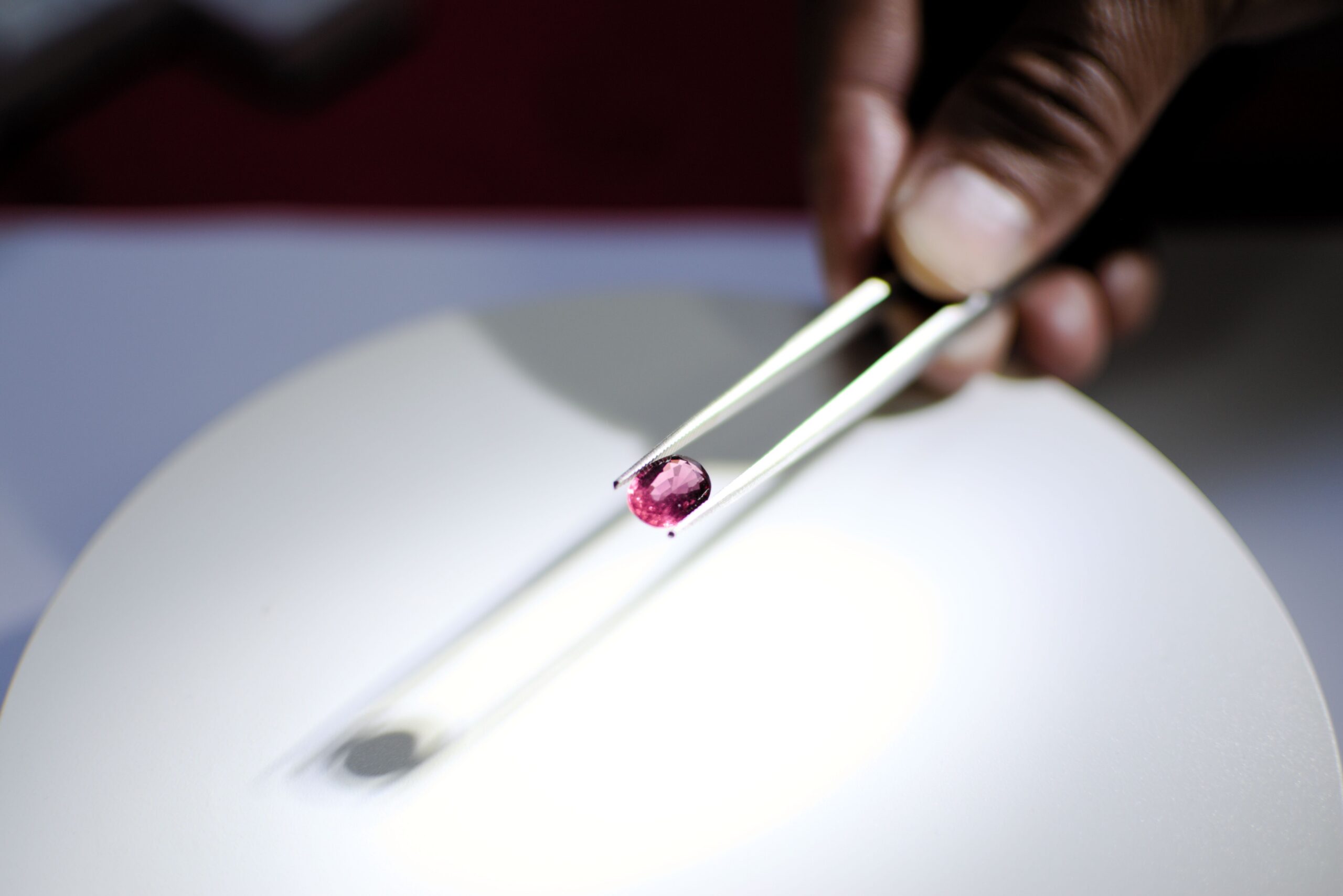
Work above a clean tray or a soft, plain surface with no open drain or floor gap below. Mounted jewellery can usually be held by a sound section of metal. A loose gem should be handled only if you can control it safely; use appropriate gem tweezers lightly around the girdle rather than gripping a point, culet or fragile edge. Do not continue if the tweezers feel unstable.
Before you lift the loupe
- Remove loose fibres and surface dust safely.
- Choose a seated position and a plain catch surface.
- Take off jewellery that could knock the item.
- Switch off a fan that may move tissue or small parts.
Stop before close handling
- A stone moves in its setting.
- A prong, hinge or clasp looks raised or open.
- The item is already cracked, bent or partly separated.
- You cannot hold a loose stone securely.
A six-step position for a steady 10× view
- Bring the loupe close to your eye. Hold its housing—not the glass—and place the lens near the eye without pressing it into your face.
- Brace the loupe hand. Rest a knuckle or the side of your hand gently against your cheek or brow so the lens and your head move together.
- Keep your posture relaxed. Sit upright, lower your shoulders and keep both eyes open if that is comfortable; closing one eye can increase strain.
- Bring the item towards the lens. Keep the loupe near your eye and move the jewellery slowly until an edge snaps into focus.
- Brace both hands together. Touch a finger or knuckle of the item hand to the loupe hand, creating a small stable frame.
- Move through the focal plane. Shift the item by millimetres, not centimetres. Refocus each area before rotating to the next view.
A loupe has shallow depth of field: you will normally see only a thin slice sharply at one time. That is expected. Do not chase the image by moving your head back and forth. Establish one focused reference—such as a girdle edge, prong tip or facet junction—then move the object carefully through the focus.
Use diffuse, side and reflected light deliberately
Bright light is not the same as useful light. A broad, neutral source can reveal the overall surface without the hard glare produced by a bare phone torch. Oblique or side light may make relief, scratches and facet edges easier to see, while light reflected through a transparent stone can reveal different internal features. Change one variable at a time: keep the item focused, then alter the direction rather than waving the light and jewellery together.
Avoid strong coloured surroundings because they may reflect into polished metal or a transparent gem. Also avoid staring into a concentrated light through the loupe. If a feature appears only at one angle, record that fact; do not assume it has disappeared when the light changes.
Scan systematically instead of hunting for a flaw
Random searching encourages you to revisit bright or dramatic areas and miss quieter ones. Choose a starting landmark, then turn the item in a fixed sequence. On a ring, you might inspect the top view, each side of the setting, the gallery, prongs and shank. On a loose faceted stone, work around the outline, then move from surface reflections towards internal views while changing focus and lighting.
Use neutral observations: “small pale line near the edge at two o’clock” is more useful than “crack”; “dark area changes when the stone turns” is safer than naming an inclusion. A feature can be surface residue, a reflection, facet doubling, an internal characteristic or damage. A loupe does not supply the testing evidence needed to decide among them.
| Possible observation | What you can record | What not to conclude |
|---|---|---|
| Surface line or abrasion | Location, length, direction and whether it remains after safe cleaning. | That it is definitely a scratch, crack or durability risk. |
| Internal-looking feature | Apparent colour, shape, relief and the angles from which it is visible. | A clarity grade, inclusion identity or treatment history. |
| Girdle or facet detail | Whether an edge looks even, chipped, inscribed or differently polished. | Authenticity, carat weight or cut grade from the view alone. |
| Setting movement or gap | Where movement appears and which component seems involved. | That bending, tightening or adhesive is a safe home repair. |
What 10× cannot confirm at home
Professional diamond clarity grading uses 10× magnification, but the number alone is not the process. Trained graders control lighting, cleanliness, viewing method and comparison standards; they consider the type, size, number, position and relief of characteristics together. A home loupe view therefore cannot assign a clarity grade or reproduce a laboratory clarity plot.
A loupe view also cannot separate natural from laboratory-grown material, identify every imitation, detect all treatments, establish monetary value or prove that a report belongs to the item in your hand. A grading document records laboratory findings at the time of examination; Laxmi’s diamond grading report guide explains what that record does and does not contain.
Similarly, spotting a possible open prong is not the same as diagnosing remaining metal thickness or choosing a repair. Stop wearing a piece that moves, catches or appears insecure and use the observations to support a professional conversation. A loupe can help you describe the location of a concern, but it is not a bench tool and cannot determine the repair method.
Photograph, describe and compare without overclaiming
Write the date, item, viewing direction, lighting and location of the feature. A simple clock-face position works for round outlines; on a ring, note whether it sits near a named prong, shoulder or inside the shank. If you take a phone photograph through the loupe, treat it as a location record rather than proof: focus processing, digital sharpening, reflections and compression can change what appears on screen.
Comparison is strongest when the conditions match. Use the same clean background, loupe, light position and orientation at a later check. A new or changing feature deserves professional review, but two different-looking phone images do not by themselves prove that damage has progressed.
Jeweller’s loupe FAQ
Should the loupe touch my eye?
No. Hold it very close so the field of view is wide, but do not press the lens or metal housing into the eye. Brace your hand gently against your face and bring the item towards the stationary loupe.
Why can I see only one small sharp area?
A 10× loupe has shallow depth of field. Focus on one reference point, then move the item by tiny amounts through the focal plane. Trying to make the whole three-dimensional piece sharp at once will cause frustration.
Is 20× or 30× better than 10×?
Not automatically. Higher power reduces working distance, field of view and depth of field, making lighting and steadiness harder. Begin with a corrected 10× loupe and use other instruments only when the question genuinely requires them.
Can a loupe tell me whether a diamond is natural or lab-grown?
No. Natural and laboratory-grown diamonds can share optical and chemical properties, and separation may require specialised testing and trained interpretation. A visible feature is not a reliable origin test.
Can I grade diamond clarity with a home loupe?
You can observe characteristics, but an official or dependable clarity grade requires trained assessment under controlled conditions and the complete grading method. Ten-times magnification is one condition, not the whole process.
Should I clean a gem every time before using a loupe?
A clean surface reduces confusing dust and fingerprints, but only use a method appropriate to the whole piece. If material, treatment, adhesive or setting condition is uncertain, ask a professional before cleaning.
What should I do if a stone moves while I inspect it?
Stop immediately, place the piece in a separate container and do not press, bend or test the setting. Record where movement appeared and arrange an in-person inspection before wearing it again.
Professional references reviewed
This guide was prepared from current Gemological Institute of America material on portable gemmological instruments, the practical limits of magnification, observation and diamond clarity at 10×. The sources support a corrected loupe, steady working distance, deliberate illumination and trained interpretation. They do not support home authentication, grading or repair diagnosis.
Research and image licence pages were checked on 3 November 2026. The instructions here are for careful observation only; they cannot establish gem identity, origin, treatment, grade, value or structural safety.
Use the loupe to ask a better question
Record what you can see, where it appears and how the light changes it. Then bring the complete piece and any available report to Laxmi Jewellers when identity, condition or maintenance needs professional evidence.
