

Tennis bracelet fit guide · Laxmi Jewellers Dubai
Why Tennis Bracelets Flip: Fit, Link Articulation and What to Check
Distinguish normal movement from repeated face-down rotation, test fit without forcing the links, and recognise when a local twist or damaged joint needs professional inspection.
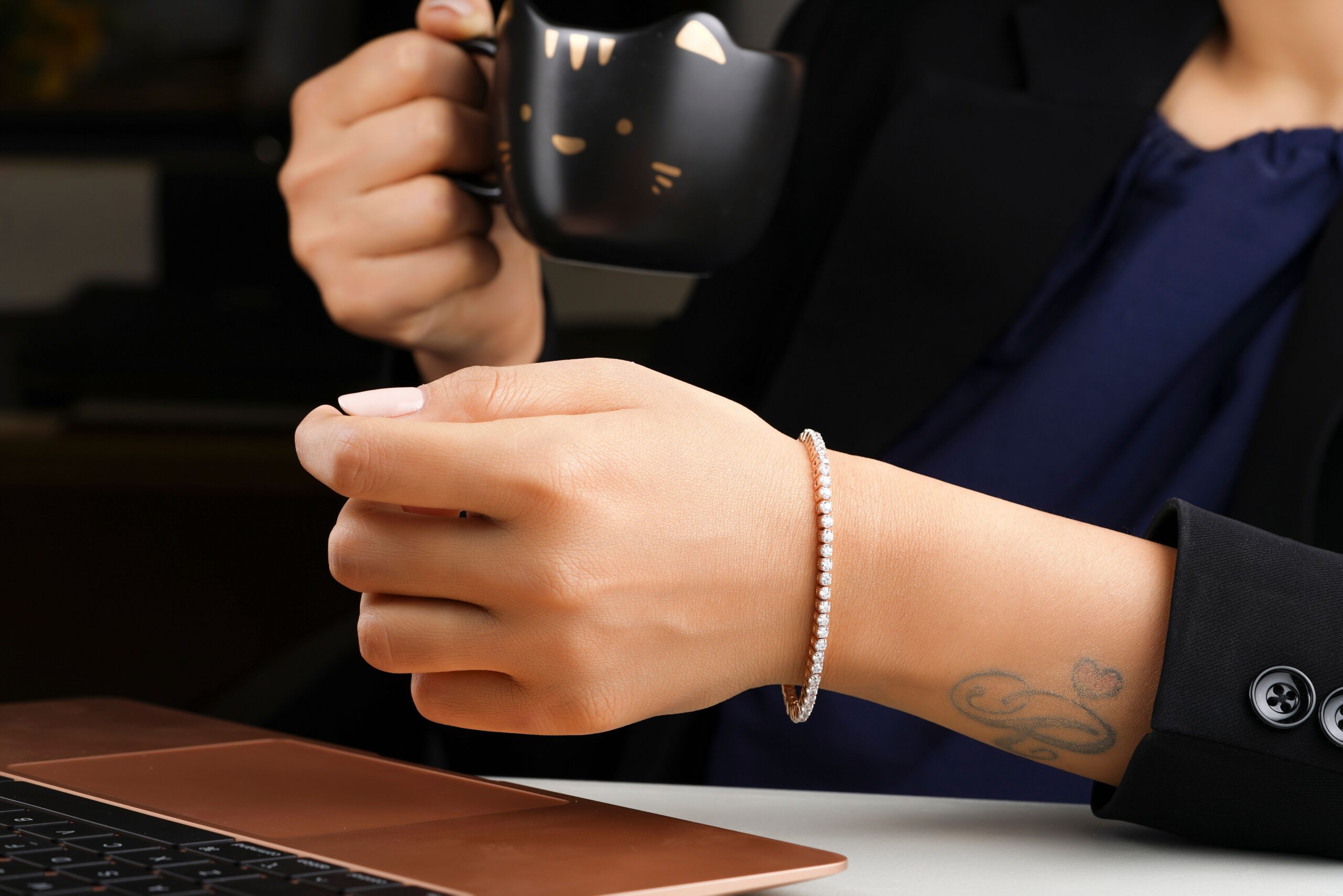
A tennis bracelet can turn for two very different reasons. The entire line may rotate around the wrist because the fit permits too much travel, or one short section may invert because adjacent links are twisted, restricted or damaged. The first is primarily a fit-and-balance question; the second is a construction-and-condition question. Identify which movement you are seeing before anyone removes links or works on the clasp.
Some movement is normal in a flexible bracelet. Repeatedly rolling fully face-down, one link that will not return to the same plane, a sharp kink, a gap that has changed, or a joint that feels stiff deserves inspection. Do not pull, flatten, oil or repeatedly bend the bracelet to “train” it. A jeweller should check fit, articulation, settings, connecting joints, clasp and safety components as one system.
Whole-bracelet rotation is not the same as one flipped link
Start by watching what happens on a relaxed wrist. If every setting remains in the same sequence and the complete bracelet turns as a unit, the piece is rotating around the wrist. If most settings remain face-up while one small area twists beneath them, the problem is local. A third pattern is a travelling twist: one inverted section moves along the line as the bracelet is handled.
| What you see | First question | Safe next step |
|---|---|---|
| The whole bracelet rolls under the wrist | Is the fit allowing excessive travel, or is the line heavily unbalanced at one point? | Check fit on the intended wrist, then ask a jeweller to assess length and balance. |
| One or two settings sit face-down | Is there a crossed link, stiff joint, altered gap or previous repair in that area? | Stop flexing that section and have the joints and stone settings inspected. |
| The line kinks when laid relaxed | Does the kink remain without tension? | Do not pull it straight; keep the piece flat and take it for assessment. |
| Movement changed suddenly | Was there a snag, impact, repair or noticeable clasp change? | Treat the change as a condition warning rather than a styling nuisance. |
This distinction prevents the wrong fix. Shortening a bracelet may reduce whole-piece travel, but it will not repair a deformed hinge. Working on a single link will not correct a bracelet that is simply much too loose. The observation comes before the remedy.
How link articulation keeps the stones face-up
A classic tennis bracelet is a flexible line of individually set stones. Each setting connects to the next through small joints or links that allow the row to curve around the wrist. That controlled articulation is what distinguishes it from a rigid bangle. The line must bend enough to follow movement, yet the connections also need to keep neighbouring settings in a predictable orientation.
When adjacent units articulate evenly, the row drapes in a smooth arc. If a connection is crossed, compressed, worn or repaired out of alignment, one section can rotate farther than intended. Dirt or dried residue can also restrict a joint, although only an inspection can tell whether stiffness is contamination, wear or deformation. Do not assume a stiff joint only needs aggressive cleaning.
Setting height and link geometry influence how the bracelet rests, but there is no universal promise that one design can never turn. A narrow line, a deeper setting, a broad articulated design and an asymmetric clasp each distribute mass and contact differently. Judge the exact piece on the intended wrist rather than applying a rule from a different construction.
Fit can encourage or reduce whole-bracelet rotation
GIA’s current buying guide describes a tennis bracelet as comfortably snug: loose enough for some movement but not so loose that it travels excessively up and down the arm. It suggests the familiar one-finger check as a useful starting point. Jewelers Mutual gives similar guidance for tennis bracelets, while also emphasising that fit depends on the wearer and bracelet style.
The one-finger check is not a manufacturing specification. Wrist shape, hand width, swelling, weather, bracelet width and setting depth can all affect comfort. Use the same wrist and the position where you normally wear the bracelet. A piece tested high on the forearm may behave differently at the wrist bone.
When the fit is too loose
The bracelet has more room to gather momentum, slide over the wrist bone and rotate as a unit. It may also catch more easily on clothing or objects.
When the fit is too tight
The line may not drape freely and the joints can be held under constant tension. Tightness can also be uncomfortable as the wrist changes through the day.
Do not solve rotation by making the bracelet as tight as possible. The aim is controlled movement without compression. If the piece needs shortening, ask how links will be removed, how the line will be rejoined, whether the visual sequence remains balanced and whether the removed links can be retained for a future adjustment.
Clasp balance, setting depth and local weight
Gravity tends to place the heavier or deeper part of a flexible bracelet at the lowest point of the wrist. On some designs, the clasp is the heaviest unit and naturally settles underneath. That can help keep the stone line face-up; on another design, an unusually heavy decorative section or altered clasp may pull the line differently. Balance should be assessed on the complete bracelet, not from the clasp alone.
A whole-piece rotation that always stops at the same position may suggest a repeatable balance point. A local inversion beside one connection is more likely to direct attention to that joint. These are diagnostic clues, not conclusions. A jeweller can compare the movement with the bracelet open, fastened, relaxed on a tray and worn on the wrist.
This article does not replace Laxmi’s separate guide to tennis bracelet clasp types. The question here is whether the actual clasp sits squarely, closes completely and works with the line—not whether a box, tongue, lobster or another closure is universally best.

Local twists, stiff joints and warning signs
Repeated flipping in one short section deserves more caution than occasional whole-bracelet movement. Look for a setting that no longer sits in the same plane as its neighbours, a connection gap that has widened, a joint that will not move through the same range, a prong that catches a fine cloth, or a stone that appears to move. Stop wearing the piece if a setting or connection may be insecure.
A snag can distort a small joint without breaking it immediately. Repeatedly straightening that joint by hand can work the metal back and forth and conceal the original event. Likewise, home oils or household lubricants can hold dirt near settings and make professional cleaning more difficult. If a link remains inverted when the bracelet is relaxed, leave it as found and transport the piece flat.
GIA advises routine checks of the clasp, safety catch and mountings on a tennis bracelet. That advice matters even when flipping is the symptom: movement can be the first visible sign that a joint or mounting has changed. Ask for the entire line to be examined, not only the link that looks wrong.
A safe at-home diagnostic sequence
- Remove the bracelet over a clear, soft surface. Work where a loose stone or component would be visible, not over a sink, hard floor or thick carpet.
- Look at the line before cleaning. Note the exact link that flips, the direction it turns and whether the problem sits near the clasp or in the centre.
- Lay it down without tension. Let the bracelet form a natural curve. Do not pull the ends apart or press a kink flat.
- Compare neighbouring links visually. Look for a changed gap, crossed connector, uneven setting height or prong that catches a lint-free cloth. Do not test prongs with a sharp tool.
- Fasten the clasp once. Confirm it closes fully and any safety device aligns. Do not repeatedly snap a reluctant mechanism.
- Try the intended wrist briefly. Observe whether the whole line rotates or the same local section inverts. Stop if anything feels sharp, tight or insecure.
- Record rather than repair. A short phone video can show the jeweller the movement that occurs in wear. Bring previous repair details and any removed links.
Gentle cleaning may remove ordinary residue, but it should not be used as a test for suspected damage. Follow product-specific advice and avoid ultrasonic cleaning when a jeweller has not confirmed the settings, stones and condition are suitable. Laxmi’s tennis bracelet buying and care guide covers broader routine care; the sequence above is limited to diagnosing flipping safely.
What a jeweller should check before resizing or repair
Describe the behaviour precisely: “the whole bracelet rolls after it passes the wrist bone” is more useful than “it flips”. Show where the line inverts and whether the issue is constant or follows a particular movement. The jeweller can then assess wrist fit, overall length, link articulation, joint wear, setting alignment, clasp seating and safety components together.
If shortening is proposed, ask whether the change could alter the visual sequence or concentrate weight at a new point. If a local repair is proposed, ask how the joint will be restored, whether heat will be used, which stones need protection or removal, and how settings will be checked afterwards. A repair should restore secure movement, not simply make the line look straight while stationary.
When comparing a new piece, fasten it and move the wrist naturally. Confirm that the bracelet can travel slightly without dropping far down the hand, that the clasp sits comfortably and that the line does not form a persistent local twist. If you plan to stack it with a watch, make that a separate decision using Laxmi’s guide to wearing a tennis bracelet with a watch safely; contact with another object can change movement and wear.
Tennis bracelet flipping FAQ
Is it normal for a tennis bracelet to move on the wrist?
Yes. A flexible line bracelet needs some movement to remain comfortable and follow the wrist. The concern is repeated full rotation, a persistent local inversion, a sharp kink or any sudden change in behaviour.
Does flipping always mean the bracelet is too loose?
No. Excessive length can encourage whole-bracelet rotation, but one flipped section may relate to a twisted or restricted joint. Identify whether the complete line or only a local area is turning before adjusting length.
How tight should a tennis bracelet be?
It should feel comfortably snug with some movement, not compression. GIA and Jewelers Mutual both describe a one-finger check as a useful starting point, but wrist shape and bracelet design still matter.
Can a jeweller shorten a tennis bracelet?
Many designs can be shortened, but the method, visual sequence, link construction and balance must be considered. Ask how the bracelet will be rejoined and keep any removed links.
Can I twist a flipped link back by hand?
Do not force it. Repeated bending can worsen a weakened connection or hide the position of a damaged joint. Leave the bracelet relaxed and let a jeweller inspect the line.
Will cleaning stop a bracelet from flipping?
Cleaning may free ordinary residue, but it will not correct a deformed joint, poor fit or worn connector. Do not use strong chemicals, steam or an ultrasonic cleaner as a diagnostic test.
Should the clasp always sit under the wrist?
It often settles underneath because of its weight and intended position, but designs differ. More important is that it closes fully, sits comfortably, aligns with the line and works with any safety device without creating a persistent twist.
Authoritative sources
- GIA 4Cs: Tennis bracelet buying guide
- GIA 4Cs: Tennis bracelet safety and maintenance checks
- Jewelers Mutual: How should a bracelet fit?
Source pages were checked on 29 October 2026. Fit guidance is a starting point, not a substitute for an item-specific inspection by a qualified jeweller.
Choose a tennis bracelet that moves with control
Compare fit, articulation, setting alignment and clasp security on the complete piece, then have any persistent twist checked before regular wear.
