

Diamond finish guide · Laxmi Jewellers Dubai
Diamond Polish vs Symmetry: What the Two Finish Grades Mean
Learn how laboratories assess surface finish and facet alignment, what common report terms mean, and why neither grade should be mistaken for a complete cut or beauty score.
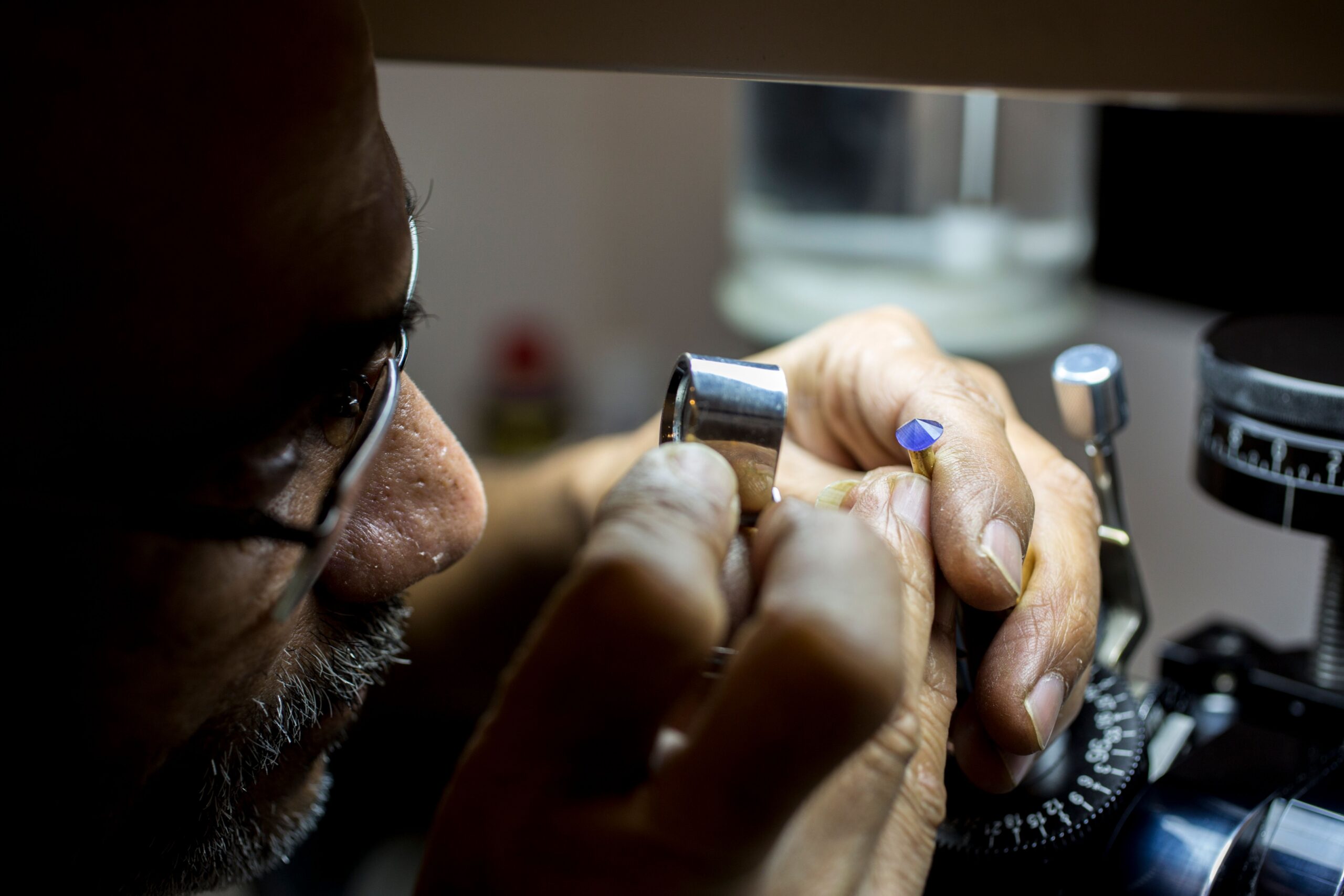
Diamond polish and symmetry are two separate assessments of a polished stone’s finish. Polish describes the condition of its surfaces and facet edges. Symmetry describes the exactness of its outline and the shape, placement and alignment of its facets. GIA assesses relevant features and their visibility at 10× magnification, then gives each field a grade from Excellent to Poor.
Polish asks how cleanly the surfaces and facet junctions were finished. Symmetry asks how precisely the outline and facets correspond to the intended cutting style. Both document craftsmanship, but neither tells you alone whether a diamond is eye-clean, how strongly it returns light or whether you will prefer its face-up appearance.
Why reports list polish and symmetry separately
Cutting a diamond involves more than selecting general proportions. The cutter creates individual facets, brings them to their intended positions and finishes their surfaces. A smoothly polished surface can belong to a diamond with a slightly off-centre table or uneven outline. Conversely, facets can be arranged accurately while a scratch, polishing line or small nick remains on the surface.
That is why a grading report normally gives polish and symmetry their own entries. Separating the fields distinguishes surface condition from geometric precision instead of compressing both into a vague description of “finish”. A report could show Excellent polish and Very Good symmetry because each is assessed independently.
The fields are also distinct from clarity. Clarity grading concerns internal inclusions and external characteristics under the laboratory’s methodology. Polish grading focuses on particular surface features associated with finishing or later wear. A surface mark can therefore matter to polish without becoming an inclusion inside the crystal.
Polish
Looks at the finished condition of facet surfaces and junctions: scratches, lines, heat-related haze, pits, nicks and related features.
Symmetry
Looks at outline and facet precision: centring, alignment, corresponding facet shapes, girdle variation and unintended deviations.
What the polish grade measures
GIA describes polish features as surface conditions produced during polishing or as blemishes created after cutting. For the polish assessment, the feature does not visibly penetrate the diamond at 10× magnification. Graders consider type, amount, position and visibility rather than merely counting marks.
A well-polished facet is intended to be smooth and reflective, meeting neighbouring facets in crisp junctions. Real diamonds may show small departures from that ideal. Some arise during manufacturing; others can result from handling, setting or wear. A feature’s name identifies what the grader observed, not how severe the final grade must be.
| Report term | Abbreviation | Plain-language meaning |
|---|---|---|
| Abrasion | Abr | Minute scratches or pits along a facet edge that make the junction look fuzzy rather than sharp. |
| Burn | Brn | A whitish haze associated with excessive heat during polishing or, occasionally, workshop heat. |
| Laser manufacturing remnant | LMR | A transparent or white groove left by laser manufacturing when it does not visibly penetrate the stone at 10×. |
| Lizard skin | LS | A transparent, uneven texture confined to a facet after polishing against the crystal grain. |
| Nick or pit | Nck / Pit | A small notch at a junction or a tiny surface opening that may appear as a white dot. |
| Scratch or polish lines | Scr / Wht / TP | A fine surface line, or parallel white or transparent lines left by the polishing process. |
A tiny, difficult-to-see line in a less prominent position is not equivalent to heavy features distributed across important facets. The laboratory judges how the features affect the finish as a whole. A retailer photograph is not a reliable diagnostic tool: dust, fingerprints, reflections, sharpening and image compression can imitate or conceal fine surface detail.
What the symmetry grade measures
Symmetry concerns the exactness of the diamond’s outline and the arrangement of its facets. The grader looks for departures from the intended pattern: whether corresponding facets are shaped and positioned consistently, whether the table and culet are centred, and whether the outline and girdle show unwanted variation.
GIA terminology includes both proportion-related and facet-related deviations. Examples include an off-centre culet or table, a round diamond that is out of round, an uneven outline, girdle-thickness variation, an extra facet, misaligned junctions and facets that do not meet at their prescribed points. Crown, pavilion or facet-angle variation can also create an asymmetrical result.
Symmetry is three-dimensional. A diamond may look orderly from one face-up position while a profile view reveals a wavy girdle, inconsistent crown height or alignment issue. The final grade reflects the collective visibility and effect of the deviations. An abbreviation can identify a feature; it is not a standalone severity score.
How to read the finish-grade scale
| Grade | Practical reading | What not to assume |
|---|---|---|
| Excellent | No relevant feature, or only minute features that are extremely difficult to see at 10×. | Not a guarantee of perfect optical patterning or preferred beauty. |
| Very Good | Minor features are present but remain difficult to see at 10×. | Not necessarily a dramatic unaided difference from Excellent. |
| Good | Features are noticeable at 10×; their unaided effect depends on type, extent and position. | Not automatically unacceptable without viewing the stone and report context. |
| Fair | More obvious or extensive features are present and may begin to affect appearance or workmanship. | Not something to judge from a seller photograph alone. |
| Poor | Prominent finish problems have a substantial effect on appearance or craftsmanship. | Not a field to ignore when comparing price or intended use. |
This is a controlled grading scale, not a promise that every adjacent grade will look different to every person. The visibility of a particular feature depends on its nature, extent, location and the diamond. When comparing Excellent with Very Good, use the report to understand the difference, then decide whether the complete diamond, price and intended setting make sense together.
Polish and symmetry are not the overall cut grade
An overall cut grade combines more information than surface finish. In GIA’s system for eligible standard round brilliant diamonds in the D-to-Z colour range, brightness, fire, scintillation, weight ratio, durability, polish and symmetry contribute to the cut assessment. Polish and symmetry matter, but they are two components within a broader evaluation.
GIA also applies finish limits within that system: an Excellent overall cut grade requires both polish and symmetry to be Very Good or Excellent. Lower finish grades can limit the overall result even when other measurements are stronger. IGI likewise assesses polish, symmetry and proportions for round brilliants. Its fancy-shape process begins with polish and symmetry before considering proportions, craftsmanship requirements and light return.
The report type and laboratory therefore matter. Do not assume every shape receives the same overall cut assessment or that different laboratories use identical calculations. Laxmi’s guide to GIA and IGI fancy-shape cut information owns that broader methodology comparison; this page stays focused on the two finish fields.
Report symmetry is not the same as optical symmetry
The symmetry line on a standard grading report evaluates craftsmanship features and deviations under the laboratory’s method. Optical symmetry describes the precision of the light-and-dark pattern produced as corresponding facets interact. Specialised hearts-and-arrows or other pattern images use controlled viewers and conditions to reveal that optical arrangement.
An Excellent report symmetry grade does not automatically guarantee a perfect hearts-and-arrows pattern. Equally, a marketing description about optical patterning should not replace the symmetry field on an independent report. Ask whether a claim concerns the standard finish grade, a specialised optical image or both.
This distinction also prevents polish or symmetry from being used as shorthand for sparkle. If your question is about light behaviour, compare the actual diamond and read Laxmi’s separate explanation of brilliance, fire and scintillation. A clean surface helps light enter and leave the stone, but an Excellent polish line is not a complete light-performance score.
A practical polish-and-symmetry workflow
- Confirm the documents are comparable. Check laboratory, report type, shape and grading scope. A standard round brilliant with an overall cut grade is not directly equivalent to a fancy shape with different report information.
- Read the two fields separately. Record both grades instead of reducing them to “finish”. Note whether either grade limits an overall cut result under that laboratory’s system.
- Translate any abbreviations. Use the issuing laboratory’s current terminology. A feature name explains type, not its severity on its own.
- Compare measurements and outline. Symmetry is easier to interpret alongside length, width, depth, table data and the face-up shape.
- View a clean diamond. Dust and fingerprints obscure surface detail. Magnification can explain the report, while normal viewing tells you whether the difference matters to you.
- Separate finish from light performance. Do not use Excellent polish as shorthand for strong brightness or symmetry alone as a sparkle score.
- Compare the complete specification. Finish is one element among origin, weight, colour, clarity, proportions, report scope, visual appeal and price.
For a field-by-field overview, use Laxmi’s guide to what a diamond grading report includes. That page explains the broader document; the workflow here helps interpret its two finish entries without stretching them beyond their purpose.
Diamond polish and symmetry FAQ
Is diamond polish the same as clarity?
No. Polish evaluates surface-finishing features such as scratches, polishing lines, burns and pits. Clarity evaluates inclusions and external characteristics under the laboratory’s clarity method. They answer different questions.
Is symmetry the same as a diamond’s shape?
No. Shape is the general outline category, such as round, oval, pear or emerald cut. Symmetry evaluates how accurately that outline and its facets execute the intended cutting style.
Is Excellent polish visibly better than Very Good polish?
Not necessarily without magnification. Very Good features are minor and difficult to see at 10× under GIA’s scale. Visibility depends on the feature, its position and the diamond, so compare the actual stone rather than assuming a dramatic unaided difference.
Can a diamond have Excellent polish but lower symmetry?
Yes. Smooth, clean facet surfaces do not guarantee that the table, culet, outline and corresponding facets are aligned with equal precision. The fields are graded independently.
Does Excellent symmetry guarantee hearts and arrows?
No. Standard report symmetry evaluates craftsmanship deviations. Hearts-and-arrows describes optical pattern precision under specialised viewing conditions and needs a separate pattern assessment.
Do fancy-shaped diamonds receive polish and symmetry grades?
Yes. GIA diamond reports include polish and symmetry assessments, although its overall cut grade is limited to eligible standard round brilliants. IGI also records finish for round and fancy shapes under its stated services.
Should I reject every diamond below Excellent polish or symmetry?
Not automatically. Check how the grade affects any overall cut result, understand the feature and its visibility, inspect the diamond and compare the complete specification and price. The report supports a precise decision; it does not make the choice for you.
Authoritative sources
- GIA: Diamond polish and symmetry terminology and abbreviations
- GIA: How GIA grades diamonds
- IGI: Diamond cut grading process
Source pages were checked on 29 October 2026. Laboratory report formats, terminology and services can change, so verify the current guidance for the exact report being compared.
Compare the report and the complete ring together
Use polish and symmetry to understand finishing quality, then compare the actual diamond’s proportions, appearance and setting as one design.
